
III-6 Sanctifying and Persevering Grace
The section “Saving and Justifying Grace” has already introduced sanctification and perseverance. We will explore them further here by providing a rigorous biblical definition, supported by key scriptural passages.
III-6-1 Sanctification
Sanctification is related to holiness and refers to the act or process by which a person becomes “holy.” The synonym for sanctification is “holiness.”.
For us Christians, sanctification is the process by which a person dedicates themselves to God and rejects sin in their life, through God’s grace. It is the process by which a believer is progressively transformed into the image of Christ, becoming more and more conformed to God’s holiness. It is a work of God, accomplished by the Holy Spirit, but it also involves the cooperation of the believer. The Holy Spirit is the primary agent of sanctification, and His work includes the purification of the believer’s heart and life. We are purified by the Word of God (John 15:3 “You are already clean because of the word I have spoken to you.”) and by the blood of Jesus Christ (1 John 1:7 “But if we walk in the light, as he is in the light, we have fellowship with one another, and the blood of Jesus, his Son, purifies us from all sin.“), not by a series of efforts on our own part, that is, not by our works.
According to the Bible, sanctification appears as a divine commandment. Here are some biblical passages:
- “Make every effort to live in peace with everyone and to be holy; without holiness no one will see the Lord.” (Hebrews 12:14).
- “It is God’s will that you should be sanctified: that you should avoid sexual immorality; ” (1 Thessalonians 4:3).
Joshua told the people, “Consecrate yourselves, for tomorrow the Lord will do amazing things among you.” (Joshua 3:5).
It is important to note that some Christian theologians place less emphasis on the role of sanctification. For example, Luther viewed sanctification as a necessary fruit but did not emphasize it as intrinsically linked to the very act of justification. In contrast, Paul and Calvin insist on the inseparability of justification and sanctification, highlighting the active role of the Holy Spirit in the transformation of the believer. The Holy Spirit is the principal agent of our sanctification, carrying out the process by which we are conformed to the image of Christ and made holy.
R.C. Sproul mentions that Christians frequently ask him, “What is God’s will for my life?” They ask all sorts of questions about choosing a spouse, a career path, and a myriad of other decisions. But the Bible is very clear about God’s primary will for our lives. The apostle Paul wrote, “It is God’s will that you should be sanctified” (1 Thessalonians 4:3a). R.C. Sproul adds: [“At other times, I hear Christians talk about being led by the Holy Spirit to do this or that. Yes, the Holy Spirit sometimes guides people toward specific goals or tasks, but His primary mission, as defined in Scripture, is to lead us to holiness. It is His power, working within us, that helps us grow in holiness.”]
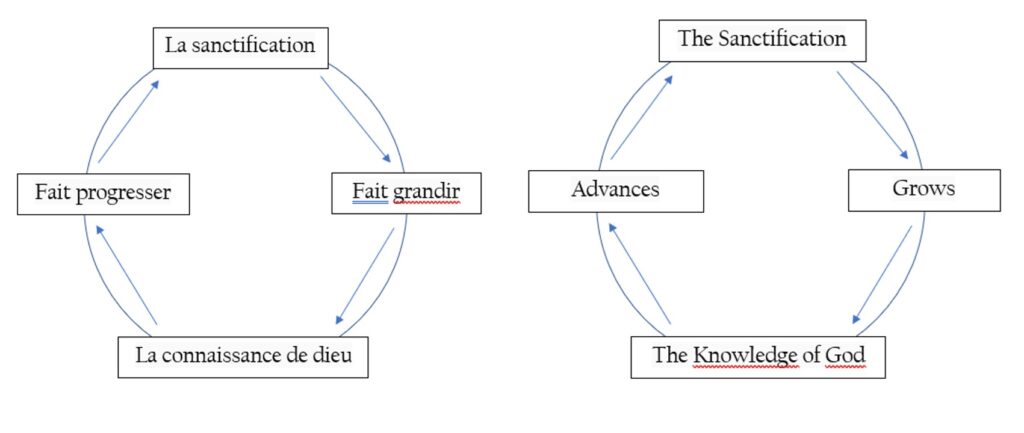
Within this framework of studying the knowledge of God, we conclude that sanctification increases the knowledge of God, which in turn, advances sanctification.
Knowledge of God and Sanctification: A Mutual Growth
The previously discussed model highlights a mutual growth between the knowledge of God and sanctification. We can imagine this as an upward spiral.
As we deepen our knowledge of God, it impacts our hearts, our desires, and our will. By better understanding God’s holiness, we are all the more motivated to seek holiness—that is, sanctification—in our own lives.
Conversely, the more we grow in sanctification, the deeper our capacity to know God becomes.
It is a dynamic and continuous process, a lifelong journey. There are times of rapid growth and others when we may feel like we are stagnating, but the important thing is to persevere in seeking the knowledge of God and in striving to live out this process of sanctification.
III-6-2 Perseverance
To be perseverant is to be patient in times of trial, firm, courageous, and not to give up in the face of opposition.
Perseverance in Christianity is the ability to stand firm, remain steadfast, and continue in the faith despite trials, temptations, doubts, and difficulties, with Jesus Christ as the model and the hope of eternal life as the motivation. This involves casting off burdens, looking to Christ, and relying on God and the community of faith for spiritual growth. It is a daily effort to remain committed to the Gospel and its teachings, transforming obstacles into lessons.
Key Concepts of Biblical Perseverance
- Joy in trials: Difficulties test our faith and produce endurance (James 1:2-4 “2 Consider it pure joy, my brothers and sisters, whenever you face trials of many kinds, 3 because you know that the testing of your faith produces perseverance. 4 Let perseverance finish its work so that you may be mature and complete, not lacking anything.”).
- Role of the Holy Spirit: God’s love, poured out by the Spirit, gives us the hope that sustains our perseverance (Romans 5:3-5 “3 Not only so, but we also glory in our sufferings, because we know that suffering produces perseverance; 4 perseverance, character; and character, hope. 5 And hope does not put us to shame, because God’s love has been poured out into our hearts through the Holy Spirit, who has been given to us.).
- Trust in God: God is sovereign and will accomplish His work in us (Philippians 1:6 “being confident of this, that he who began a good work in you will carry it on to completion until the day of Christ Jesus.”).
Why persevere?
- To grow spiritually: Every challenge becomes an opportunity for growth.
- To overcome failures: Failure is not an end, but a stepping stone to continue.
- To reach the goal: Perseverance leads to spiritual success and divine reward.
And
- Perseverance is essential for salvation since God promises eternal life to those who persevere to the end (John 10:28 “I give them eternal life, and they shall never perish; no one will snatch them out of my hand.”, John 17:3 “Now this is eternal life: that they know you, the only true God, and Jesus Christ, whom you have sent.”).
- Perseverance leads to endurance, character, and hope (Romans 5:3-5).
- More than a quality, perseverance is a fundamental attitude that strengthens the Christian life (2 Corinthians 4:16-18 “16 Therefore we do not lose heart. Though outwardly we are wasting away, yet inwardly we are being renewed day by day. 17 For our light and momentary troubles are achieving for us an eternal glory that far outweighs them all. 18 So we fix our eyes not on what is seen, but on what is unseen, since what is seen is temporary, but what is unseen is eternal.”).
How to persevere?
- Keep your eyes fixed on Jesus: He is the perfect model of perseverance in the face of opposition. Cast your burdens on the Lord: Entrust your burdens to God instead of carrying them yourself.
- Draw inspiration from those who came before us: Look to the lives of the believers who preceded us.
- Support one another: The faith community plays a crucial role.
- Remain committed to the Word: Continue to apply the teachings, even when it’s difficult.
- Maintain hope: Remember that present sufferings are nothing compared to future glory.
III-6-3 Sanctifying Grace
We are limiting the presentation of sanctifying grace to only two perspectives: Calvinist and Arminian/Wesleyan.
Calvanist vision
Since saving grace is already effective and infallible among Calvinists, it is necessary to understand what sanctifying grace means in this context where salvation is assured.
1. Sanctifying Grace is a Continuation of Saving Grace
For Calvinists, sanctifying grace is not a separate, “new” grace, but the natural extension of saving grace. Inevitably, whom God justifies, He also sanctifies (Romans 8:30 “And those he predestined, he also called; those he called, he also justified; those he justified, he also glorified”).
Sanctification flows from regeneration. Once the heart is renewed by the Holy Spirit, the believer begins to manifest the fruits of faith (Galatians 5:22-23 “22 But the fruit of the Spirit is love, joy, peace, forbearance, kindness, goodness, faithfulness, 23 gentleness and self-control. Against such things there is no law.”).
2. Sanctifying Grace is a Progressive but Assured Work
Calvinists recognize that sanctification is not instantaneous, but progressive. The believer still struggles against sin (Romans 7:18-25), but this struggle is sustained and supported by grace.
In other words, sanctification is not the condition of salvation, but its inevitable effect. God works in the believer to produce both the will and the action according to His purpose (Philippians 2:13 “for it is God who works in you to will and to act in order to fulfill his good purpose.”).
Thus, sanctifying grace is the energy of God at work in the believer’s life to conform him to the image of Christ (Romans 8:29).
3. Human Responsibility Maintained
Even though sanctification is assured by grace, the believer remains actively involved.
Calvin liked to say: “God does not sanctify the lazy.”.
The believer cooperates, not to earn grace, but because grace is already at work in him.
This tension is expressed in Philippians 2:12–13 “12 Therefore, my dear friends, as you have always obeyed—not only in my presence, but now much more in my absence—continue to work out your salvation with fear and trembling, 13 for it is God who works in you to will and to act in order to fulfill his good purpose.”
Sanctification is therefore synergistic, but grace retains the initiative and the primary power.
Arminian/Wesleyan Vision
Arminians and Wesleyans understand sanctifying grace differently, in contrast to the Calvinist view.
1. Grace Offered, Not Imposed
In contrast to the Calvinist view where sanctification is inevitable for the elect, Arminians and Wesleyans affirm that sanctifying grace always operates through voluntary cooperation. Philippians 2:12–13 is interpreted here as a partnership between God and humanity: “Work out your salvation… for it is God who works in you to will and to act.”
This means:
- God continually offers His grace for sanctification,
- but the believer can resist or cooperate with it,
- therefore, sanctification progresses to the extent that a person remains open and obedient to this grace.
- It is a dynamic relationship between human freedom and divine faithfulness.
2. Grace That Fully Restores the Image of God
For Wesleyans in particular (following John Wesley): Sanctification is not merely moral improvement, but a restoration of the heart to perfect love for God and neighbor. They often speak of “Christian perfection”—not the absence of sin, but a heart wholly devoted to God, purified from selfish affections (1 Thessalonians 5:23 “May God himself, the God of peace, sanctify you through and through. May your whole spirit, soul and body be kept blameless at the coming of our Lord Jesus Christ.” and Matthew 5:48 “Be perfect, therefore, as your heavenly Father is perfect.”).
Thus, sanctifying grace among Wesleyans is more radically transformative than among Calvinists, but it always depends on the believer’s continued cooperation.
III-6-4 Persevering Grace
Calvanist vision
1. The Principle: The Perseverance of the Saints
This is the fifth point of the famous TULIP acronym (P = Perseverance of the Saints). It affirms that those whom God has truly regenerated cannot lose their salvation.
Why? Because it is God himself who keeps them in the faith until the end (John 10:28–29 “28 I give them eternal life, and they shall never perish; no one will snatch them out of my hand.29 My Father, who has given them to me, is greater than all; no one can snatch them out of my Father’s hand.”).
Thus, persevering grace is the continuation of saving and sanctifying grace, which prevents the believer from falling away permanently.
2. Perseverance is not the absence of falling
Calvinists recognize that believers may fall into sin and experience doubts or periods of spiritual weakness. But persevering grace always lifts them up, leads them to repentance, and keeps them in the faith (Philippians 1:6 “being confident of this, that he who began a good work in you will carry it on to completion until the day of Christ Jesus.”).
3. God Alone Guarantees the End of the Journey
(Already mentioned in the section “Saving and Persevering Grace”)
For Calvinists, salvation is a complete act of God:
- God elects → prevenient grace (in its Calvinist version)
- God calls → irresistible grace
- God justifies → saving grace
- God sanctifies → sanctifying grace
- God enables perseverance → persevering grace
- God glorifies → final fulfillment.
Each step depends on God’s faithfulness, not on human constancy (Romans 11:29 “For God’s gifts and his call are irrevocable.”).
Arminian/Wesleyan Vision
1. No Absolute Guarantee of Perseverance
Arminians reject the Calvinist doctrine of the “perseverance of the saints.”. For them, God’s grace provides the real possibility of persevering to the end, but it does not automatically guarantee the outcome.
A believer can remain faithful through persevering grace, or freely turn away through unbelief or persistent rebellion (Hebrews 6:4–6 “I4 It is impossible for those who have once been enlightened, who have tasted the heavenly gift, who have shared in the Holy Spirit, 5 who have tasted the goodness of the word of God and the powers of the coming age 6 and who have fallen away, to be brought back to repentance. To their loss they are crucifying the Son of God all over again and subjecting him to public disgrace.” and 2 Peter 2:20–22 “20 If they have escaped the corruption of the world by knowing our Lord and Savior Jesus Christ and are again entangled in it and are overcome, they are worse off at the end than they were at the beginning. 21 It would have been better for them not to have known the way of righteousness, than to have known it and then to turn their backs on the sacred command that was passed on to them. 22 Of them the proverbs are true: “A dog returns to its vomit,” and, “A sow that is washed returns to her wallowing in the mud.””).
In other words:
- God is faithful to sustain, but He never forces faithfulness.
- Love remains free, even after conversion.
2. Persevering Grace is an Accompanying Grace
For Wesleyans, God “walks with us” through His grace at every step, but we must continue to respond. This is a more relational view because Grace is not an automatic guarantee, but a faithful presence that continually calls us to remain in Christ (John 15:4–6 — “4 Remain in me, as I also remain in you. No branch can bear fruit by itself; it must remain in the vine. Neither can you bear fruit unless you remain in me. 5 “I am the vine; you are the branches. If you remain in me and I in you, you will bear much fruit; apart from me you can do nothing.6 If you do not remain in me, you are like a branch that is thrown away and withers; such branches are picked up, thrown into the fire and burned.” “REMAINING” is not guaranteed, but offered continuously.
3. In Wesleyan theology, Sanctification and Perseverance are Linked
John Wesley saw entire sanctification (perfect love) as the best assurance of perseverance.
In other words,
- The more a believer is sanctified, the more firmly they remain in grace.
- Faithfulness becomes stable not through compulsion, but through transformation of the heart.
III-6-5 Synthetic comparative table
| Aspect | Calvinism | Arminianism / Wesleyanism |
| Nature of sanctifying grace | Effective grace, necessarily acting in the elect | Grace continually offered, acting through cooperation |
| Human role | Active response made possible by grace, but not decisive | Free and constant cooperation with grace |
| Result of sanctification | Inevitable transformation toward holiness (God is the primary author) | Progressive transformation according to the believer’s faithfulness |
| Nature of persevering grace | Divine guarantee: the elect necessarily persevere to the end | Constant help from God, but a real possibility of abandoning the faith |
| Security of salvation | Absolute and infallible for the elect | Conditional: depends on continued faith |
| Keyword and Conclusion | Assurance Sanctifying grace acts effectively and persevering grace guarantees salvation. | Faithfulness Sanctifying grace invites cooperation, and persevering grace accompanies without compelling. |

In Christ's Love