
III-3 Irresistible Grace
Presenting the doctrine of irresistible grace in a few sentences is a real challenge. Furthermore, one must choose one’s words carefully to avoid inadvertently distorting Calvinist thought on this subject.
I will therefore strive to offer a clear and faithful summary.
First, it is crucial to note that the doctrines of grace, as articulated in Calvinism, uphold the sovereignty of God, human depravity, and the necessity of divine grace for salvation.
The absolute sovereignty of God is a central biblical theme in Calvinism. Irresistible Grace is one of the five points of Calvinism summarized by the acronym TULIP.
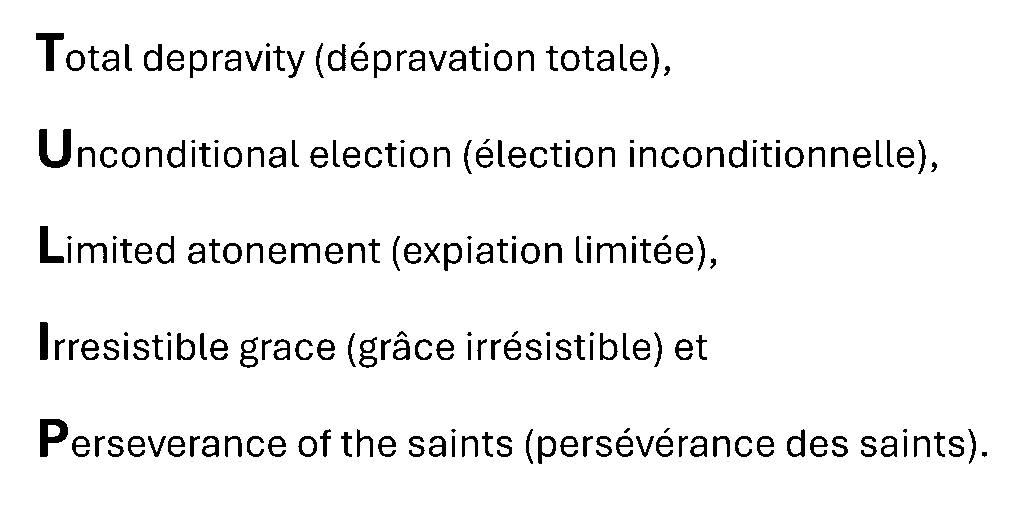
The “I” in TULIP represents Irresistible Grace.
According to this doctrine, God’s grace cannot be effectively rejected once it is offered to the elect. The idea is that God does not wait for human approval to act, but intervenes so that the elect person accepts salvation.
Prevenient grace, understood as God’s help that precedes human acceptance, is therefore partly present, but the major difference lies in the irremissibility of this grace.
It is important to note that Calvinism does not deny that God’s grace precedes salvation, but that this grace is “irresistible” and is realized only upon the elect, unlike other theological traditions.
Calvinists consider their theology to be a faithful, rigorous interpretation of the Bible. They meticulously defend their doctrine of irresistible grace with the seven essential points in their biblical interpretation.
1- The Depraved Nature of Man
In his utter depravity, man is incapable of turning to God on his own. Sin affects every facet of his being, including his capacity to respond to the Gospel. Without divine intervention, no one seeks God.
Genesis 6 :5 « The Lord saw how great the wickedness of the human race had become on the earth, and that every inclination of the thoughts of the human heart was only evil all the time. “
Romans 3:10-12 “… There is no one righteous, not even one; … there is no one who seeks God. … there is no one who does good, not even one.”
2- The Need for Regeneration Before Being Able to Respond to the External Call of the Gospel
Faced with this powerlessness, Scripture affirms that regeneration (or new birth) is essential for humankind to believe. This regeneration is the exclusive work of the Holy Spirit, who precedes and makes faith possible. Without it, the outward call of the Gospel remains a misunderstood and rejected message.
John 3:3-8 “… Very truly I tell you, no one can see the kingdom of God unless they are born again… Flesh gives birth to flesh, but the Spirit gives birth to spirit…”
John 6:63-65 “The Spirit gives life; the flesh counts for nothing. … This is why I told you that no one can come to me unless the Father has enabled them.”
3- The Transforming Power of the Holy Spirit
Irresistible grace is the sovereign action of the Spirit which, by regenerating the heart, makes God’s call effective and inevitable, and enables man to respond to the Gospel with faith and repentance. Man becomes a new creation.
2 Corinthians 3:18 “And we all, who with unveiled faces contemplate the Lord’s glory, are being transformed into his image with ever-increasing glory, which comes from the Lord, who is the Spirit.”
Ezekiel 36:26-27 “26 I will give you a new heart and put a new spirit in you; I will remove from you your heart of stone and give you a heart of flesh. 27 And I will put my Spirit in you and move you to follow my decrees and be careful to keep my laws. “
4- The Nature of Saving Faith Produced by the Spirit
Faith is the fruit of regeneration and is itself a gift from God. The key point of Calvinism lies in this: Regeneration does not flow from faith, but faith flows from regeneration; that is, God first opens the heart, and the person then believes in response to this transformation. It is necessarily accompanied by repentance, obedience, and perseverance. Regeneration precedes repentance and faith.
1 John 5:1 “Everyone who believes that Jesus is the Christ is born of God, and everyone who loves the father loves his child as well.”
Acts 13:48 “When the Gentiles heard this, they were glad and honored the word of the Lord; and all who were appointed for eternal life believed.”
John 6:37 “All those the Father gives me will come to me, and whoever comes to me I will never drive away.”
5- Effectiveness of the Spirit
When God decides to regenerate a person, His work cannot fail.
Grace works effectively, changing a heart of stone into a heart of flesh. The “golden chain” of salvation is a famous expression from the Cavinist, taken from Romans 8:29-30 « 29 For those God foreknew he also predestined to be conformed to the image of his Son, that he might be the firstborn among many brothers and sisters. 30 And those he predestined, he also called; those he called, he also justified; those he justified, he also glorified.”.
- Predestination: God sovereignly chooses those whom he will save.
- Effective calling: God calls the elect through irresistible grace, which overcomes their natural resistance to salvation.
- Justification: The elect are declared righteous by faith.
- Glorification: They are ultimately made perfect in eternal glory.
6- Preserving Human Responsibility With the Capacity to Choose Freely
Calvinists maintain that man acts freely and chooses voluntarily according to his desires and nature, but is bound to his original sin, of which he is a slave. Before regeneration, in his fallen nature, he is incapable of choosing spiritual good, especially of choosing God without divine intervention.
After the new birth (or regeneration), man is freed from the bondage of sin. He is enlivened, sensitive to God’s voice, and acts freely, but by the power of the Holy Spirit now desires what God desires.
Although his will is renewed, it is not yet perfect—hence the need for sanctification and continued perseverance (the need to be sustained by sanctifying and persevering grace).
7- Source of Assurance and Adoration
Irresistible grace is a promise. Those whom God calls will be infallibly saved. Salvation depends entirely on divine mercy, excluding any human glory. It reminds believers that their salvation is an unmerited gift, prompting them to praise God for his faithfulness and unconditional love. This strengthens their trust in God and motivates them to live a life of gratitude and service.
1 Corinthians 1:31 invites us to humility, gratitude, and complete trust in God’s faithfulness (« Therefore, as it is written: “Let the one who boasts boast in the Lord.””).
The four stages of the golden chain described in point 5 are guaranteed by God, and those whom he has chosen are assured of their eternal salvation.
For Calvinists, irresistible grace (intimately linked to predestination) is a source of hope and worship, for it guarantees that the salvation of the elect is sure and certain. It compels them to praise God for his grace and mercy, while acknowledging that his justice is perfect. The certainty of salvation for the elect is a source of comfort and peace. Predestination reminds believers that their salvation rests entirely on God, leading them to worship and gratitude.
III-3-1 What Kind of Link Is There Between Prevenient Grace And Irresistible Grace?
Although the concepts of prevenient grace (Calvinists prefer to call it common prevenient grace) and irresistible grace are often distinguished in their role and effect, Calvinists consider that there is a link between them, but that this link is not direct and lacks continuity, since these two graces express two stages that do not have the same process.
This link is described as a theological connection, but viewed from God’s perspective, not from humanity’s.
- God sustains the world and restrains evil through universal common prevenient grace, which touches all humans but does not lead to salvation. He acts throughout the world through his common grace. This is the manifestation of his goodness toward all creation.
- God regenerates the hearts of the elect through irresistible and efficacious saving grace, which acts only or particularly in the elect and produces faith.
Like the metaphor of the sun which illuminates and warms everyone (common prevenient grace), but melts the ice only where the heart opens to its warmth (irresistible grace which transforms certain hearts according to God’s plan).
III-3-2 Dilemma Between God's Love and Predestination
Calvinists acknowledge that predestination is a mystery that surpasses human reason, often citing Romans 11:33 “Oh, the depth of the riches of the wisdom and knowledge of God! How unsearchable his judgments, and his paths beyond tracing out!”.
They admit that we cannot fully understand why God chooses some and not others, but they assert that this does not mean that God is unjust or lacks love.
- Predestination is an eternal and sovereign decree of God, which cannot be judged according to human standards.
- God’s love is not limited to what we humans can perceive or understand.
For Calvinists, predestination does not limit God’s love; it reveals it as entirely free and sovereign.
God does not love those he does not save “less”; rather, he manifests his perfect justice toward sin, while revealing his infinite grace toward the elect.
Reprobation is not arbitrary.
Calvinists affirm that God does not create evil in the hearts of the reprobate, but leaves them in their state of sin, which is just (Romans 9:23-23 “22 What if God, although choosing to show his wrath and make his power known, bore with great patience the objects of his wrath—prepared for destruction? 23 What if he did this to make the riches of his glory known to the objects of his mercy, whom he prepared in advance for glory).
Reprobation is not a “positive will” of God to condemn individuals, but a decision not to grant them saving grace.
Reprobation manifests the glory of divine justice, just as election manifests the glory of mercy.
In conclusion, predestination does not mean that God “rejects” some without reason, but that he acts according to a divine plan that transcends our understanding, while remaining fully good and just. In other words, Calvinists accept the irreducible mystery in which God loves all people, but in infinite wisdom, he grants salvation selectively, not to diminish his love, but to manifest his glory in the diversity of his attributes: love, justice, mercy, and holiness.
John Calvin himself wrote: “Where God closes his mouth, we must also cease to speak.”
We will have the opportunity to read about the confrontation between Calvinist doctrine and that of Arminius/Wesley in the section on resistible grace.

In Christ's Love