I- Introduction
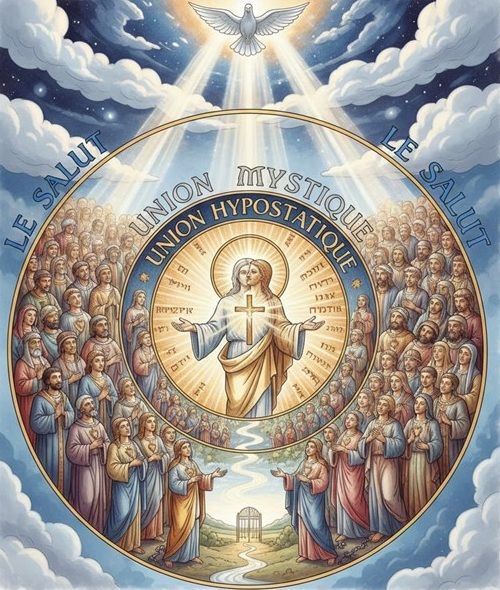
The relationship between hypostatic union, mystical union, and salvation can be understood as an organic theological articulation, where each of these realities plays a distinct but inseparable role in the economy of salvation. The hypostatic union, by which the divine and human nature are united in the person of Christ, constitutes the ontological foundation of the redemptive work. The mystical union then expresses the effective participation of believers in this work, through their incorporation into Christ. Salvation thus appears as the fruit of this double union, actualized in human existence by grace.
These three pillars are coherently articulated at the heart of Christian Christology. It is therefore appropriate to examine each of these concepts in turn in order to better understand the way in which God, “in Christ”, restores human nature to its source and brings about the union of humanity with divine life, an act by which salvation is objectively acquired for humanity.

Prayer:
Heavenly Father, I thank You from the bottom of my heart for sending Your only Son, Jesus Christ, out of love for us. Thank you for this priceless sacrifice that saves us, forgives us and offers us eternal life. Your infinite grace and compassion transform our lives and fill us with Your eternal love.
In the name of Christ! Amen!
II- Reflection
II-1 Hypostatic union
In his book “Hypostatic Union of Christ”, Jude Irenaeus traces the history of this concept through the first centuries of Christianity. The book shows how the hypostatic union gradually became clearer over the course of controversies and councils, culminating in a central doctrine of Christianity describing the union of two natures — divine and human — in one and the same person (or “hypostasis”), Jesus Christ who is both fully God and fully man. These two natures are neither mixed, nor confounded, nor modified by their union.
The foundations of a reflection on the nature of Christ began in the second century with Justin of Nablus, Irenaeus of Lyons and Tertullian. During The Arian Crisis in the fourth century, Athanasius of Alexandria forcefully defended the full divinity of Christ against Arianism, which denied this divinity. The Council of Nicaea (325) affirmed that Christ is “consubstantial” with the Father, marking a decisive step in the formulation of the hypostatic union. The Council of Ephesus (431) reaffirmed the unity of the person of Christ and condemned Nestorianism, which separated the divine and human natures of Christ too radically. At the Council of Chalcedon (451), the definitive formula of the Hypostatic Union was produced and remains a reference for Christian Christology.
Theologians such as Cyril of Alexandria played a key role in the formulation of this doctrine, insisting on the unity of the person of Christ despite the distinction of His natures.
Jesus Christ is both fully God and fully man
Eternally God, He assumed human nature at His incarnation through the virginal conception of Mary. This incarnation enables Him to truly identify Himself with the human condition and His weaknesses (Hebrews 2:17 “For this reason he had to be made like them, fully human in every way, in order that he might become a merciful and faithful high priest in service to God, and that he might make atonement for the sins of the people.”), and above all to accomplish the redemptive work by offering His life as a ransom for sins through His death on the cross (Philippians 2:5-11). Thus, the doctrine of hypostatic union affirms that, without confusion or alteration of natures, Christ is one person, truly God and truly man, for eternity.
Don’t fall into mistakes
Remember the following details to avoid errors.
- The nature of “Man” and that of “God” are united. This union is:
- No Confusion: They don’t mix to create a “third nature” (like pink is the mix of red and white). Jesus is not a “half-God, half-man”.
- Without change: Divinity does not become humanity, and humanity is not absorbed by divinity. Each nature keeps its properties intact.
- Without division: One cannot separate the “Jesus man” from the “Jesus God”.
- Without separation: They always act together as one person.
A metaphor for this union is the image of iron being heated red.
- Iron and fire are two distinct natures.
- Iron does not become fire, and fire does not become iron (no melting/mixing).
- Yet, in hot iron, the two are totally united: if you touch iron, you touch the heat of fire. Iron works with the power of fire.
How had the hypostatic union taken place?
The kenosis of Christ (from the Greek kenosis, “emptying” or “humiliation”), described in particular in Philippians 2:5-8, refers to the act by which the Son of God, while remaining fully divine, “emptied” or “humiliated” himself by taking on human nature, accepting the limitations and suffering of the human condition. This concept, to which a chapter in the first collection was devoted, is often seen as the movement by which God makes himself accessible to humanity. Christ’s kenosis describes that Jesus sometimes submitted to human limitations (John 4:6, 19:28) and at other times acted by the power of His divinity (John 11:43, Matthew 14:18-21). In both cases, it was the unique person of Jesus who was acting. Jesus had two natures, but one personality.
There is a close and inseparable relationship between these two concepts “Kenosis” and “Hypostatic Union”, because they describe two facets of the same precise event that theology calls the Incarnation. If the hypostatic union describes the “what” (the state of Jesus), kenosis describes the “how” (the act of humility). This relationship is seen as one of complementarity and logical dependence between these two concepts. Without kenosis, there would be no incarnation, and therefore no hypostatic union. But the hypostatic union is the doctrine that defines the permanent reality of Christ after the incarnation. Kenosis is therefore the means by which the hypostatic union is achieved.
Imagine a king who renounces his privileges to live as a peasant (kenosis). Once he has taken on this identity, he is both king and peasant in one person (hypostatic union). Kenosis is the act, the hypostatic union is the reality that follows from it.
In other words, without kenosis, the hypostatic union could not have taken place. Kenosis is therefore the necessary condition for the hypostatic union to exist.
- The initiative comes from the “Logos” who assumes a human nature and who has decided to add a human nature to His divine nature (John 1:14 “The Word became flesh and made his dwelling among us…”). In order for the union to be perfect and sinless, human intervention is limited. From the moment of conception, Jesus’ human nature never existed apart from His union with the divine person of the Son. There is the uniqueness of the subject since there is only one “I” in Jesus. The “I” of Jesus is indeed that of the divine person of the Son of God, and not of a separate human person. This hypostatic union means that in Jesus, human nature and divine nature are united in one person, “the Son”, making His consciousness and words Divine. When He says, “I thirst”, it is the Divine Person who is expressing a need of His human nature. When Jesus resurrects someone, it is the Divine Person who acts through His divine nature.
The Council of Chalcedon declares that for union to take place without destroying one of the two natures, certain truths must be maintained:
- The divinity does not become limited.
- Humanity does not become all-powerful.
- They coexist perfectly in the unity of the person of Christ.
How is the Hypostatic Union Maintained?
The Bible mentions that the Holy Spirit is the agent that makes possible and sustains the union between divinity and humanity in Jesus Christ. Here are the details of His role:
- Formation of union: The Holy Spirit is the One who has “prepared” and “formed” the human nature of Christ to be united with the divine person of the Son without confusion (Luke 1:35 “The angel answered, “The Holy Spirit will come on you, and the power of the Most High will overshadow you. So the holy one to be born will be called the Son of God.”).
- Sustaining the union: Although Jesus was God, He lived out His earthly ministry relying on the Holy Spirit so that His human nature would act in perfect harmony with His divine nature (Luke 3:21-22 “21 When all the people were being baptized, Jesus was baptized too. And as he was praying, heaven was opened 22 and the Holy Spirit descended on him in bodily form like a dove. And a voice came from heaven: “You are my Son, whom I love; with you I am well pleased.””. Acts 10:38 “how God anointed Jesus of Nazareth with the Holy Spirit and power, and how he went around doing good and healing all who were under the power of the devil, because God was with him.”).
- The Bond of Faithfulness in the Sacrifice: The union was maintained even in the extreme suffering of the Passion, where the Spirit sustained the humanity of Jesus to remain subject to the divine will (Hebrews 9:14 “How much more, then, will the blood of Christ, who through the eternal Spirit offered himself unblemished to God, cleanse our consciences from acts that lead to death, so that we may serve the living God!”).
- The Guarantee of Resurrection: The hypostatic union is not broken by death; the Spirit is the one who restores life to the human body of Jesus, thus confirming His identity as the Son of God (Romans 8:11 “And if the Spirit of him who raised Jesus from the dead is living in you, he who raised Christ from the dead will also give life to your mortal bodies because of his Spirit who lives in you.”).
Kenosis and Hypostatic Union: Abstract Theological Concepts?
In short, like the doctrine of the Trinity, the doctrine of Kenosis and the doctrine of hypostatic union remain a mystery beyond full human comprehension. The very nature of God exceeds the capacities of the finite intelligence, and the human mind cannot claim to grasp the divine infinity exhaustively. Jesus had always been God (John 8:58, 10:30), but through His incarnation, He became a human being (John 1:14). The union of human nature with divine nature gave Jesus Christ, the God-man who is both fully God and fully man.
However, by faith, these two doctrines become a theology that is not abstract, since they are the very engine of salvation. Without the Incarnation and this dual nature, reconciliation between God and humanity would be impossible.
Meditation: Do not confuse the persons in the Trinity or divide the person of Christ. Thus, while the Trinity expresses personal plurality within the one essence of divine nature, the hypostatic union affirms the personal unity of Christ in the real distinction of His two natures.
II-2 Union Mystique
The mystical union is fundamentally different from the hypostatic union. It does not concern the ontological constitution of the person of Christ, but the spiritual and relational experience of believers. It designates the living communion established between God and the faithful, a communion that is based on divine grace and the voluntary acceptance of man.
In this union, the believer remains fully a creature and does not become God by nature; he is, however, made a partaker of the divine life by grace. This union is offered to all the faithful and is actualized by faith, prayer and, according to Christian tradition, by the sacraments. Biblical images, such as that of “the vine and the branches” in John 15, are privileged illustrations of this reality of vital and fruitful communion.
The apostle Paul himself calls the mystical union a “great mystery” when he compares the Christ-church relationship to marriage (Ephesians 5:31-32 “31 “For this reason a man will leave his father and mother and be united to his wife, and the two will become one flesh.”-32 This is a profound mystery—but I am talking about Christ and the church.”).
In this collection, a chapter has been devoted to union with Christ. The reader will find in it the foundation of mystical union through the union with Christ in which the believer begins to participate in the divine life.
Mystical union (unio mystica) and union with Christ refer globally to the same theological concept. Although the terms may vary according to tradition, they both refer to the intimate, vital, and spiritual relationship between the believer and Jesus Christ.
In Protestant (especially Reformed) theology, union with Christ is often called “mystical union” because it is supernaturally achieved by the Holy Spirit and goes beyond mere human understanding.
The mystical union further emphasizes the experiential and transformative aspect of the relationship, where Christ truly dwells in the heart of the faithful through His Spirit.
In Christology, mystical union is simply the formal theological designation of what the Bible calls union with Christ. It is the starting point of the Christian life: it is because we are united to Him that we receive His benefits.
Ecclesial Union in The Mystical Union
Generally speaking, mystical union refers to the union of the believer with Christ. On the theological level, this union is not limited to an individual dimension, but also includes an ecclesial dimension: the communion of the faithful with Christ and with each other within the Church, the body of Christ. Mystical union is thus accomplished in both a personal and corporate way, in the community of believers.
Paul describes the church as the body of Christ (1 Corinthians 12:12–27), a living spiritual organism, united with its Lord, where believers share together in one life, one faith, and one grace (Ephesians 4:15–16). The metaphor of the church as the “bride of Christ” (Ephesians 5:22–27) expresses this intimate union, marked by sacrificial love, faithfulness, and sanctification, directed toward its eschatological fulfillment at the marriage of the Lamb (Revelation 19:7 “Let us rejoice and be glad and give him glory! For the wedding of the Lamb has come, and his bride has made herself ready.”).
Union with Christ thus engenders the spiritual unity of believers, a visible manifestation of ecclesial union within the mystical union, in accordance with Christ’s prayer for the perfect unity of those who are “in him” (John 17:21-23 “21 that all of them may be one, Father, just as you are in me and I am in you. May they also be in us so that the world may believe that you have sent me. 22 I have given them the glory that you gave me, that they may be one as we are one— 23 I in them and you in me—so that they may be brought to complete unity. Then the world will know that you sent me and have loved them even as you have loved me.”).
The Role of the Holy Spirit in Mystical Union
1- The Holy Spirit as Agent of the Mystical Union
The Holy Spirit is the “prolonger” of the incarnation. If the hypostatic union united God with humanity in the person of Jesus, it is the Holy Spirit who makes this union real and personal in the life of every believer.
John 15, the central text on the mystical union, describes it fully, but implicitly (“abide in me”, “I abide in you”), and the role of the Holy Spirit is real without being explicitly named. From a Johannine and theological point of view, John 15 must be read in immediate continuity with John 14 and John 16, where the Spirit is clearly introduced as the Agent of this union.
In John 14, 15 and 16, the Holy Spirit is presented as the decisive agent of the mystical union between Christ and believers. Through His coming, communion with Christ becomes interior, lasting and alive, fulfilling the promise: “you in me, and I in you”. The Spirit dwells the believer in Christ and communicates His life, ensuring spiritual fruitfulness, perseverance in the truth, and continuity of the Lord’s teaching. This union is neither abstract nor symbolic, but relational and dynamic: Christ lives in his disciples through the Spirit, who leads them into truth, unites them to Trinitarian love and commits them to mission, so that the glory of the Son may be manifested in the world.
2- The Holy Spirit as a sanctifier
The New Testament clearly presents the Holy Spirit as the principal agent of sanctification, that is, of the progressive transformation of the believer into the image of Christ. This work is interior, continuous and profoundly Christological: The Spirit communicates the life of Christ and reproduces its moral dispositions in those who belong to him.
Paul makes it explicit in Romans 8:13-14: “13 For if you live according to the flesh, you will die; but if by the Spirit you put to death the misdeeds of the body, you will live. 14 For those who are led by the Spirit of God are the children of God.”. Sanctification here is attributed to the action of the Spirit, who enables the believer to resist sin and live according to God’s will. It is the sign of a real and living filiation.
Similarly, 2 Corinthians 3:18 states, “And we all, who with unveiled faces contemplate the Lord’s glory, are being transformed into his image with ever-increasing glory, which comes from the Lord, who is the Spirit.”. Conformity to Christ is not the fruit of a mere external imitation, but the result of a transforming work carried out by the Spirit, which renews the inner being and leads the believer to spiritual maturity. Thus, sanctification appears as the concrete unfolding of union with Christ, brought about and maintained by the Holy Spirit.
3- Complementary roles of the Holy Spirit in the life of the believer
The New Testament presents the Holy Spirit as exercising several essential complementary roles in the life of the believer, all closely related to mystical union with Christ.
He is first and foremost Comforter and Guide. Jesus promises “another Comforter” who will dwell with the disciples and lead them into all truth (John 14:16–17 “16 And I will ask the Father, and he will give you another advocate to help you and be with you forever— 17 the Spirit of truth. The world cannot accept him, because it neither sees him nor knows him. But you know him, for he lives with you and will be in you.”). The Spirit accompanies the believer inwardly, enlightens his discernment and sustains his faith in trial.
The Holy Spirit is also a source of inner strength. Paul asserts that God strengthens believers “with power by His Spirit in the inward man” (Ephesians 3:16 “I pray that out of his glorious riches he may strengthen you with power through his Spirit in your inner being,”), enabling them to persevere, to resist sin and to live according to the Christian calling.
It is also powerful for ministry and witness. Jesus declares, “But you will receive power when the Holy Spirit comes on you; and you will be my witnesses in Jerusalem, and in all Judea and Samaria, and to the ends of the earth.” (Acts 1:8) Through spiritual gifts, the Spirit builds up the Church and makes mission possible.
Finally, the Spirit is the agent of fidelity to the New Covenant. According to God’s promise, He is given so that the believer may walk according to God’s will (2 Corinthians 3:3 “You show that you are a letter from Christ, the result of our ministry, written not with ink but with the Spirit of the living God, not on tablets of stone but on tablets of human hearts.”).
These functions converge towards the same goal: to make communion with God alive, to manifest the life of Christ in the believer by the power of the Spirit, to unite the members to Christ and to each other, to distribute the gifts for common edification, and to lead the Church to holiness and spiritual maturity.
II-3 Relation to Salvation
Some Christian authors use explanatory metaphors to articulate the relationship between hypostatic union, mystical union, and salvation. This articulation can be understood as a “chain of transmission”: the hypostatic union, by which the eternal Son assumes human nature, constitutes the objective source of salvation; the mystical union represents the vital link by which the believer is effectively united to Christ; and salvation is the visible consequence of this, comparable to the light that is kindled when the connection is made.
The same relationship can also be illustrated by a spatial image: the hypostatic union appears as the bridge established by God Himself, connecting fallen humanity to divine life; mystical union corresponds to the act by which the believer enters this bridge, that is, abides “in Christ” by faith; salvation, finally, is accomplished in the effective passage to the other shore, symbolizing reconciliation with God, peace and participation in eternal life.
III- Conclusion
Ultimately, the hypostatic union, the mystical union, and salvation are closely intertwined and form a coherent whole. The hypostatic union is the foundation of salvation in Christ. The mystical union enables the believer to appropriate this salvation through faith and through the work of the Holy Spirit. Salvation is its culmination.
These three realities lie at the heart of Christian Christology: salvation is possible because God united Himself to humanity in Jesus Christ, and it becomes a reality for the individual when he is united to Christ and participates in His life and His glory.
Prayer:
Heavenly Father, I give You thanks for Your immeasurable love. Thank You for giving Your only Son, Jesus, to redeem me. I acknowledge the sacrifice of Your Son as the supreme expression of Your mercy. Thank You for offering me forgiveness and the promise of eternal life through Him. I love You, Father, and I thank You for Your infinite goodness.
In the name of Christ! Amen !
Bibliography
Union Hypostatique du Christ (Livre) par Jude Irenaeus
Qu’est-ce que l’union hypostatique du Christ ? (UnHerautDansLe.net)
Union with Christ (CSLewisInstitute.org)
IV. The Mystical Union (Extrait du live “Systematic Theology” par Louis Berkhof)
L’union avec Christ est mystérieuse (ToutPourSaGloire.com)
In Christ's Love