I- Introduction
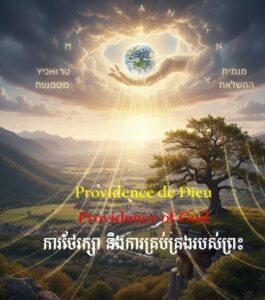
The word “providence” does not exist in the Hebrew Bible (Old Testament) or in the New Testament.
John Piper, in his book “The Providence of God”, offers a definition of the word “Providence” by explaining that (here is the excerpt) [the term “providence” is constructed from the Latin provideo, itselfmade up of two elements: pro (“forward”, “on the part of”), and video (“see”). One might think that the word provideo isdefined as “to see ahead” or “to foresee”, but it really means “to provide for what is necessary”, “to give help and support”. Thus, when it refers to God, “providence” means “the act of intentionally providingfor the world, or supporting and directing it”.
It could therefore be that by combining the Latin words video (“to see”) and pro (“to, towards”) the term composed did not simply take on the meaning of “foresee”, but ratherthat of “to watch to”, that is to say, “take care of” or “make sure it happens”. This is the meaning of God‘ s providence: he sees to it that things happen in a certain way.]
However, the idea of God caring, guiding and protecting His creatures is very present in the Bible. Believers find passages in Scripture expressing divine care, such as in the Psalms or the Sermon on the Mount, which express the concept of providence without using the word.
Although the word is absent, the central message of the Bible states that God is active in the world, guiding, supporting, and protecting humans, which corresponds to the theological notion of providence developed later.
Christian theologians, such as:
- Origen (third century) is considered the first systematic theologian to comment on Scripture, integrating the ideas of providence into a Christian framework, long before formal theology existed.
- Thomas Aquinas (thirteenth century) systematized the theology of divine providence, linking the will of God to the governance of the world, strongly influencing Catholic thought.
- John Calvin (sixteenth century) developed a very influential doctrine, distinguishing between general providence (universe) and particular providence (salvation), and confronting it with the challenges of evil. It was Calvin who produced one of the most influential and comprehensive theological formulations of the concept.
The doxology of Romans 11:36 expresses faith in God to which Christian providence is closely linked (Romans 11:36 “For from him and through him and for him are all things. To him be the glory forever! Amen.”).
In the introduction to his book “The Providence of God”, the British Reformed philosopher and theologian Paul Helm states that providence is a central theme of the Christian faith, because it touches on God’s action in the world, on the relationship between human freedom and the divine will, with prayer and with the problem of evil. and that it profoundly shapes our conception of God as well as the way we serve and worship Him.
According to John Piper, God’s providence refers to His intentional sovereignty by which He sustains and governs all creation, with wisdom, justice, and goodness, directing history—including trials—toward His redemptive purpose and the glory of God in Jesus Christ.

Let us pray: O Holy Spirit, divine breath, source of all wisdom, I stand before You humbly. I have such a hard time understanding God’s ways and His providence in my life. Send upon me Your gifts of Wisdom and Intelligence so that I may see things with Your eyes. Enlighten my heart and mind so that I may grasp Your love, even in the midst of trials. I want to accept what God allows, submit to His will, and trust in His perfect plan for me. Guide me, teach me, strengthen me. Through Jesus Christ our Lord. Amen!
II- Reflection
Essential Distinction Between Providence and Predestination
Providence is God’s solicitude for His creation, watching over the world and individuals on a daily basis. God acts all the time, but often in subtle ways. It is therefore about how God governs the world day in and day out, sometimes allowing evil for a greater good, while acting for His children.
Whereas predestination is a stricter doctrine, especially in Calvinism, asserting that God has from all eternity chosen some individuals for salvation and others for damnation, an immutable divine plan that determines the final fate.
The key difference is that providence is a continuous, general action, while predestination is an eternal, selective decision about one’s final fate, raising debates about free will. Predestination is a specific and often controversial aspect of this divine governance, directly affecting the eternal salvation of the soul. A person can believe in providence without adhering to strict predestination.
The question of divine providence
This capacity of God to provide, sustain and direct the world constitutes the crossroads where the sovereignty of God and the fragility of man meet. If the idea of an intentional plan is common to the Christian tradition, it takes on radically different colors depending on the way we look at it. From the Christocentric vision of the Apostle Paul, the source of all theological reflection, we will journey through the tragic realism of Pascal, the paradoxical confidence of Luther and the ordained government of Calvin. How can we reconcile human freedom, the existence of evil and divine omnipotence? It is in this dialogue between faith, reason and experience that the mystery of the direction of the world is drawn.
Whereas Descartes, the question is not posed in terms of “salvation of the soul” or “heart”, but in terms of metaphysical mechanics, logic and philosophy, although he is deeply and authentically Christian. If classical thought, from Paul to Pascal, treats providence as a spiritual drama involving the salvation of the soul, it should be distinguished from the purely metaphysical approach of Descartes. Where theologians and the apologetic question the relationship between grace and will, Descartes limits himself to noting divine preordination as a logical necessity of the infinite. However, he has his own reasons in his approach and approach that we will present below.
Relationship Between the Creator and His Creatures
The relationship between the Creator and His creatures is central to the doctrine of providence, for divine providence is God’s way of wisely and lovingly guiding all creatures to their ultimate end, thus revealing His plan and His love, and making each individual an instrument for accomplishing His purposes. despite the mystery of evil. This relationship implies that God is the first cause of everything, but that creatures have a secondary causality, while being governed by a divine love that aims at their union with God.
Divine providence is a very broad subject that has been debated for centuries both philosophically and theologically.
It fascinated the philosophical and scientific thinkers of the seventeenth century, such as Descartes and Pascal, not so much as a scientific subject in the modern sense, but as a metaphysical, philosophical reality underlying their vision of the world. Descartes deduced it from reason (the perfect idea of God), and Pascal felt it through the heart, considering it essential to guide life in the face of the mystery of existence and evil. Descartes and Pascal both link God to providence and divine sovereignty, but with diametrically opposed approaches: Descartes seeks God through reason and the cogito (I think, therefore I am), seeing him as a perfect first cause from which the world derives, while Pascal opposes a “God of the heart” (Providence) to a God of the philosophers, insisting on the absolute sovereignty of God in the face of human misery and the necessity of faith, a difference that shows their distinct approach to divine causality: one by reason (first cause), the other by the heart (Providence).
II-1 Descartes and Providence
For Descartes, God is the perfect first cause, linked to reason and to the creation of the world, provable by metaphysics, binding man to God through perfection. In the context of his philosophy, and particularly in the Discourse on Method, Descartes makes a clear distinction between the realm of faith (revealed truth) and that of reason (natural truth). He relies on reason rather than faith to align himself with providence and considers that questions concerning God and the soul must be resolved by philosophy (natural reason) rather than by theology, in order to be convincing to all, that is, to all humanity, believers and non-believers alike. He does not “privilege” faith in his method, does not mean that he ignores it, but that he relies on faith when he addresses only believers. For Descartes, human reason given by God can only lead us to the “threshold” of religion by proving the existence of God and the immortality of the soul, but faith is an act of adhesion that requires divine grace and cannot be the simple result of a mathematical demonstration. Yet he uses reason to establish a solid foundation for what faith was already affirming, but with a very specific intention.
How does Descartes justify the use of reason to apprehend providence, while respecting the “depth” of faith?
In the Cartesian system, it is reason that proves God that guarantees the validity of reason. Aligning oneself with providence through reason is therefore not a transgression, does not mean waiting for a miracle, but using one’s reason to understand the laws that God has sovereignly imposed on the world and also the natural outcome of human intelligence. By understanding these laws (physical and moral), man agrees with the divine will.
Descartes relies on the following reasons for aligning himself with providence through reason:
- Descartes affirms that faith and reason can never contradict each other since they both come from God (the one through the creation of our mind, the other through revelation), and that a truth of faith cannot be contrary to a truth of reason. He seems to “abandon” faith in favor of reason, not to diminish God, but to secure science. He seeks to make science and reason compatible with providence without having to invoke revelation to prove physical truths. For him, God established the laws of nature in the beginning, and the role of science is to understand how these laws work autonomously and mechanically.
- For Descartes, faith is certainly deeper (it touches on the salvation of the soul and the divine mysteries), but it is personal and based on grace. Now, in “The Discourse on Method”, Descartes wants to convince everyone (the believer, the atheist and the skeptic), by using reason as a universal “tool of certainty”, because it is the “natural light” common to all men.
- Reason explains how this works in the physical world: through the establishment of immutable laws and the creation of eternal truths, while faith tells us that God watches over us and that His providence exists (this is a certainty of heart and revelation).
- Descartes used Reason to protect Faith since in his time, nascent science (Galileo, etc.) seemed to threaten the religious vision of the world. By using reason to prove that God is the guarantor of scientific laws, Descartes makes a stroke of genius – by proving that the more we do science (reason), the more we discover the perfection and constancy of God (providence) and – by transforming reason into an ally of faith: it does not replace it, but it shows that the world is rational because its creator is perfect.
The Limit of Reason on Incomprehensibility
This is the point at which Descartes stops. He uses reason to prove that God is sovereign. Descartes almost never resorts to faith in his philosophical demonstrations. He always seeks to explain everything by reason, but he recognizes and admits that reason cannot “understand” the infinite.
According to him:
- Reason is sufficient to prove the existence of God, the necessity of providence, and the order of the world.
- Faith intervenes only where reason reaches its limits. Faith alone can accept the depth and mysteries of this providence (divine infinity, free decrees, grace, salvation, immortality of the soul, evil, suffering or free will)
In short, for Descartes, reason is not “above” faith, it is its logical framework in the material world. He uses reason to make providence “clear and distinct” to the human mind, while leaving to faith the dimension of the sacred and the ineffable.
How Descartes Uses Reason to Explain Divine Providence
This is the domain of Cartesian philosophy and metaphysics, not theological, even if it is part of a Christian framework. Descartes shows that reason can understand and justify God’s action in the world, without recourse to revelation.
- God as First and Conservative Cause
Descartes starts from the principle that God is the first cause of all that exists. By reason, he demonstrates that God, being perfect, cannot be deceitful (otherwise he would be imperfect). He deduces from this that God, in creating the world, gave it stable and intelligible laws, and that He continually sustains it in existence (continuous creation theory). Without this constant divine action, the world would return to nothingness. Thus, providence manifests itself as an act of preservation and direction, for God maintains the order and coherence of the universe at every moment.
Example: In “The Third Meditation”, Descartes writes that God “is not only the cause of my existence, but also of everything that happens to me”. This means that God, through His providence, ensures the persistence and intelligibility of the world.
- The order and perfection of the world
Descartes uses reason to show that the world, despite its apparent imperfections, is ordered and governed by mathematical and physical laws. This order is the mark of providence: God wanted a rational world, understandable by man. The regularity of the laws of nature (such as those of mechanics) is a proof of this intentional direction.
Key argument : If God is perfect, He cannot have created a chaotic or absurd world. Human reason, in discovering these laws, also discovers God’s providential intention.
- Providence and human freedom
Descartes explains that God, in His providence, has given man freedom and reason. Even if man is wrong, this does not call into question the divine goodness: it is the imperfect use of our free will that generates error. Providence, here, is the act by which God provides man with the necessary tools to reach the truth, without constraining him.
Quote : “God has put in me a faculty of judgment so that I can discern the true from the false.” (Meditations).
- God as the Guarantor of Clear and Distinct Truth
For Descartes, providence is also manifested in the fact that God guarantees the truth of our clear and distinct ideas. When we perceive something clearly, it is God who, through His providence, assures us that this perception is true. Thus, reason, properly used, allows us to participate in the providential order.
- A non-interventionist providence
Descartes rejects the idea of a God who constantly intervenes in the details of the world (as in some theologies). For him, providence is above all the initial establishment of a perfect order, which God then sustains without the need to make constant corrections.
Descartes’ Optimism
For Descartes, divine providence is not a simple matter of faith, but a truth demonstrable by reason. It is the reason that, in discovering God’s perfection, makes us optimistic about our ability to know the truth and act in accordance with a benevolent divine will, despite our own imperfection.
II-2 Pascal and Providence
For Pascal, Descartes’ intimate adversary, God is the sovereign Providence, linked to faith and to the miserable condition of man. This sovereignty is not understood only by reason or as a simple cause of the world, but is revealed to the heart. He advocates a God of faith, sensitive to the heart, a God of love that we seek in the experience of our own misery. For Pascal, man is mistaken by relying too much on his reason and imagination, sources of pride. Pascal’s doctrine on divine providence is indeed based on the idea that “God is sensitive to the heart, not to reason”, meaning that the knowledge of God is a matter of intuition and faith (the heart), because rational evidence is insufficient to grasp the truth of the Christian faith, which fills both the greatness and the misery of man. The “heart” for Pascal is not only emotion, but a superior cognitive faculty capable of grasping the fundamental truths that reason alone, discursive, cannot reach.
Blaise Pascal’s vision of divine providence is very close to that of Augustine of Hippo, to the point that it can be said that Pascal is directly inscribed in the Augustinian tradition, especially through the prism of Jansenism, which is characterized by a rigorous and pessimistic interpretation of Augustinian doctrine, the main key points of which are:
- Anthropological pessimism : Man, corrupted by original sin, cannot save himself by his own strength. He is incapable of good without grace. Human nature, profoundly marked by sin, makes any cooperation with grace difficult, if not impossible, without divine intervention.
- Efficacious, irresistible grace: Those whom God elects cannot resist His grace.
- Absolute predestination : God sovereignly chooses those whom He saves, without their works changing anything.
- Mystery of Providence: God’s plans are unfathomable and that providence acts in a hidden way, often incomprehensible to man.
- Free Will Subordinated to God’ s Grace and Sovereignty: Human freedom is real, but its effectiveness depends entirely on grace. On this point, the position of Pascal and the Jansenists is radical, since they insist on the impotence of man and the omnipotence of God. Pascal recognizes free will, but considers it an unfathomable mystery, especially in the face of God’s omnipotence and as ahuman being, affirming that man is free to choose, but his choices are determined by grace or by his own corruption.
The expression of his Christian thought and faith is found in the works “Pensées” (Religious Writings), “The Memorial” (Moving Text of His Faith in Christ) and “The Provincials” (Defender of Jansenism).
“The Memorial”, his intimate manuscript, discovered sewn into the lining of his cloak after his death, recounts an intense mystical experience of the “Night of Fire” of November 23, 1654, when he felt an encounter with the living God of Jesus Christ, and not that of the philosophers. This manuscript also reaffirms his faith with notes of ecstasy, certainty and submission, marking a decisive turning point in his life and theological work.
How does Pascal describe divine providence?
Pascal’s vision is extremely close to those of Augustine and the Jansenists, but with important nuances that will be developed later. Pascal approaches divine providence in a metaphysical, existentialist, and mysterious way, insisting on the idea that God provides, sustains, and directs the world and history, but according to designs that go beyond human reason (as opposed to the Cartesian vision).
Here are the four key points of divine providence according to Pascal, with excerpts from Pascal’s “Thoughts”:
- Providence as God’s intentional act
Pascal does not propose a systematic definition of providence, but he speaks of it through images, paradoxes, and spiritual experiences:
- God acts with intention, but His purposes are hidden: “God willed to save the elect, and to damn the rest.”, “God’s Ways Are Impenetrable.”. For Pascal, providence is not a blind mechanism, but the expression of an intentional divine will, even if its reasons escape us.
- Providence as a hidden order : “Everything that happens is in accordance with the order of God, but this order is a mystery.”. Pascal, influenced by Augustine, sees in providence a divine plan that goes beyond human logic, but which is revealed in faith.
- Providence as support and direction of the world
Pascal describes providence as an active force that:
- Sustains the existence of the world : “God is the center of all, and the circumference is nowhere”. Providence is what keeps the universe in being, even if man, blind, does not always perceive this action.
- Directs history and events: “Jesus Christ is the goal of all, and the center to which all things tend.”. Providence is not a mere preservation, but a direction of history towards an end: the salvation of the elect.
- Acts in details as well as in grand designs: “A movement of God’s hand can change the whole face of the world.”. Pascal, as a scientist, knows that the laws of nature are stable, but he sees in apparent accidents (such as the death of a king, an encounter, an illness) the discreet action of providence.
- Providence and the human condition
Pascal always links providence to the misery of man and to the necessity of grace:
- Man is unable to save himself alone: “Without grace, man can only sin.”. Providence provides for what man cannot obtain by himself: salvation.
- Providence is revealed in the experience of faith: “God of Abraham, God of Isaac, God of Jacob, not of philosophers and scientists.”. Providence is not an abstract idea, but a reality lived in the encounter with God.
- Providence and mystery
Pascal insists on the unfathomable nature of providence:
- “The last step of reason is to recognize that there are an infinity of things that surpass it.”.
- “We can only know God in Jesus Christ.”. Providence cannot be explained, it is lived and received in humility.
Pascal’s own nuances in relation to Augustine and the Jansenists
Pascal is a philosopher, mathematician, physicist, an essential figure in French literature and unquestionably considered a major theologian. In these writings, he uses terms and phrases with striking imagery and rhetoric that is more accessible than the Jansenist theological treatises. Unlike Augustine or the Jansenists, he integrated a reflection on natural laws (probability, physics) as an expression of the providential order. On the whole, Pascal has a more modern sensibility of the Jansenist vision and a radical position of the Augustinian vision.
Pascal’s Pessimism
Through his work entitled “Thoughts”, pessimism is one of the most striking aspects of Pascal’s thought. This pessimism is primarily centered on the human condition, but in a radical, systematic, and paradoxical way. Some suggest that it would be more accurate to say that he is a tragic realist. It is not a question of a general pessimism about the world or life, but of a ruthless analysis of the nature, limits and contradictions of the human being, always in tension between greatness and misery, qualified as the “duality of greatness and misery”. Pascal warns us against entertainment by denouncing it (“The only thing that consoles us for our miseries is entertainment, and yet it is the greatest of our miseries.”).
Pascal’s pessimism can be characterized as pessimism:
- Anthropological: Themisery of man (“Man is only a reed, the weakest in nature, but a thinking reed.”)
- Epistemological: The limits of human reason (“The heart has its reasons that reason does not know.”)
- Existential: Entertainment and boredom (“All the unhappiness of men comes from one thing, which is not knowing how to rest in a room.”)
- Moral: Man is evil (“Justice without force is powerless; Force without justice is tyrannical. or “Man is more wicked than he thinks.””)
- Paradoxal: Man is capable of thought, science, morality, but fragile, inconstant, incapable of absolute truth, and condemned to die (“Man is neither angel nor beast, and misfortune dictates that whoever wants to be an angel makes a beast.”)
- And metaphysical: An indifferent universe (“The eternal silence of these infinite spaces frightens me.”).
However, this pessimism is not absolute, and Pascal proposes a way out: faith in God and grace:
- “Without grace, man can only sin.”. Only divine grace can save man from his misery.
- “Believe in God, and you will be happy.”. (The Bet) Pascal invites us to bet on the existence of God, because it is the only way to give meaning to life.
We can conclude that Pascal’s pessimism is salutary. This is not despair, but a realistic diagnosis of the human condition. It aims to humiliate reason and open man to transcendence.
For Pascal, to recognize one’s misery is to take the first step towards God.
Pascal Memorial
GOD of Abraham, GOD of Isaac, GOD of Jacob
not of the philosophers and of the learned.
Certitude. Certitude. Feeling. Joy. Peace.
GOD of Jesus Christ.
My God and your God.
Your GOD will be my God.
Forgetfulness of the world and of everything, except GOD.
He is only found by the ways taught in the Gospel.
Grandeur of the human soul.
Righteous Father, the world has not known you, but I have known you.
Joy, joy, joy, tears of joy.
I have departed from him:
They have forsaken me, the fount of living water.
My God, will you leave me?
Let me not be separated from him forever.
This is eternal life, that they know you, the one true God, and the one that you sent, Jesus Christ.
Jesus Christ.
Jesus Christ.
I left him; I fled him, renounced, crucified.
Let me never be separated from him.
He is only kept securely by the ways taught in the Gospel:
Renunciation, total and sweet.
Complete submission to Jesus Christ and to my director.
Eternally in joy for a day’s exercise on the earth.
Not to forget your words. Amen.
II-3 Luther and Providence
Pillars of Lutheran Theology
Like all Protestant theology that emerged from the Reformation, the central Lutheran doctrine is essentially based on the “Five Solas”, which summarize its pillars. Justification by faith is the center of gravity of Lutheran doctrine and Martin Luther’s Reformation, meaning that humans are declared righteous by God not by their works, but only by faith in Jesus Christ, receiving salvation freely by divine grace.
Here are the key concepts summarized in the founding texts of Lutheranism:
- Grace Only: Salvation comes only from the grace of God, an undeserved gift.
- Faith Alone: Faith in Jesus Christ is the only way to receive this grace and be justified. Faith is the crux of his doctrine. Man is made righteous by God, not by his own merits or works, but by divine grace through faith in Christ.
- Scripture Alone: The Bible is the only source of authority and inspiration for Christian faith and practice.
- Christocentrism: Christ and His redemption (His death and resurrection) are at the center of doctrine and preaching.
- Universal priesthood of believers: Every believer has direct access to God, reducing the need for intermediaries.
How does Luther describe divine providence?
Martin Luther describes God’s providence as an intentional, constant, and benevolent action by which God provides for all the needs of His creation, sustains the universe, and directs all things according to His sovereign and merciful will. God is an omnipresent, active and irresistible force and holds every cog in every moment of life. His idea of the “hidden God” (Deus Absconditus) is a radical affirmation of divine sovereignty, which so terrifies his contemporaries. Here is how Luther develops his concepts, based on biblical verses that he often quotes and comments:
- Providence as God’s Intentional Act
Luther insists that God does not act at random, but with a precise purpose and a clear will:
- “God is the one who feeds the birds of the air and clothes the lilies of the field.” (Matthew 6:26-30) Luther comments, “If God takes care of the birds and the flowers, will he not take care of you, who are worth much more in his eyes?”
- “And my God will meet all your needs according to the riches of his glory in Christ Jesus.” (Philippians 4:19) For Luther, this verse shows that providence is personal and concrete : God works in the details of daily life.
- Providence as the constant support of the world
Luther sees in providence the continuous action of God who maintains the existence of the world and takes care of it:
- “… He causes his sun to rise on the evil and the good, and sends rain on the righteous and the unrighteous.” (Matthew 5:45) Luther emphasizes that God sustains all beings, even those who do not recognize Him.
- “For in him we live and move and have our being.’ As some of your own poets have said, ‘We are his offspring.” (Acts 17:28) Luther interprets this verse as proof that everything depends on God at every moment (In Him we live, we move, and we exist).
Quote from Luther: “God is not content with creating the world, he governs and sustains it every day, as a father feeds and protects his children.”
- Providence as the Direction of History and Events
For Luther, God directs not only nature, but also human history and individual events:
- “And we know that in all things God works for the good of those who love him, who have been called according to his purpose.” (Romans 8:28) Luther applies this verse to the lives of believers: even trials are ordained by God for their good.
- “In the Lord’s hand the king’s heart is a stream of water that he channels toward all who please him.” (Proverbs 21:1) Luther often quotes this verse to show that even the powerful are under the control of divine providence.
Concrete example: Luther saw in his own life (his conversion, his protection during the Reformation) the hand of providence. He writes: “If God had not watched over me, I would have died a thousand times.”
- Providence and the believer’s trust
Luther links providence to faith and trust in God:
- “31 So do not worry, saying, ‘What shall we eat?’ or ‘What shall we drink?’ or ‘What shall we wear?’ 32 For the pagans run after all these things, and your heavenly Father knows that you need them.” (Matthew 6:31-32).
- “I was young and now I am old, yet I have never seen the righteous forsaken or their children begging bread.” (Psalm 37:25). Luther uses this psalm to encourage believers to put their lives in God’s hands.
Key quote: “Providence is like God saying, ‘Let me do it, I’ll take care of everything.’”.
- Providence and misfortune: a mystery
Luther recognizes that providence also includes trials and sufferings, but he interprets them as purifying trials or as means of bringing man back to God:
- “because the Lord disciplines the one he loves, and he chastens everyone he accepts as his son.” (Hebrews 12:6) Luther commented: “Even misfortunes come from the hand of God, who disciplines us like a father.”
- “If we are distressed, it is for your comfort and salvation; if we are comforted, it is for your comfort, which produces in you patient endurance of the same sufferings we suffer.” (2 Corinthians 1:6).
Warning : Luther rejects the idea that misfortunes are arbitrary punishments. For him, everything is ordained by God, even if we do not always understand His purposes.
- Providence and human responsibility
Unlike Calvin, Luther does not deny human responsibility :
- “Do not work for food that spoils, but for food that endures to eternal life, which the Son of Man will give you. For on him God the Father has placed his seal of approval.” (John 6:27) Luther teaches that man must act, but always in dependence on God.
- “For even when we were with you, we gave you this rule: “The one who is unwilling to work shall not eat.”” (2 Thessalonians 3:10). Providence does not cancel human effort, but supports it.
Lutheran balance: “Pray as if everything depended on God, and work as if everything depended on you.”
- Providence and the concept of the “revealed God (Deus revelatus) / The hidden God (Deus absconditus)”
The idea that God hides and reveals himself at the same time is a dizzying abstraction or duality so abstract for the human mind! This tension between mystery and presence, between silence and speech, between transcendence and closeness, has been at the heart of theological, philosophical and even existential reflection for centuries.
This duality is at once disconcerting, even frightening, but fruitful for man.
God is hiding. How?
- God does not want to be an object of knowledge, but a subject of relationship. To hide is to invite man to seek Him and to test faith.
- By veiling Himself, God leaves man the choice of whether to believe or not.
- It is a mystery that reminds us that God is beyond anything we can imagine.
Luther’s idea of “God is hiding” does not deny God’s absolute sovereignty in His providence, but it does emphasize that God, in His unfathomable majesty, is totally beyond human comprehension and can act in ways that are incomprehensible, even terrifying, to man.
Luther relies on several scriptural passages to justify this idea (Isaiah 45:15 “Truly you are a God who has been hiding himself, the God and Savior of Israel.”, Romans 11:33 “Oh, the depth of the riches of the wisdom and knowledge of God! How unsearchable his judgments, and his paths beyond tracing out!”).
Here is a key quote from Luther: “God in his majesty is a devouring fire, an unapproachable light, an unfathomable depth. […] He is not the one we imagine, but the one He is in Himself.”
Luther asserts that “God is hiding” is not bound to conform to our ideas of justice or goodness and that He does what He wills, and no one can tell Him.
Opponents of this idea of “God is hiding” feared that this doctrine would lead to fatalism or despair: if God is totally unfathomable, how can He be trusted?
But Luther responded with the “God reveals himself”: “We must stick to the revealed Christ, and not speculate on the hidden God.”.
But God reveals himself. How?
- By nature, which is a silent language of His power and beauty.
- Through the presence of God in silence, prayer, or moments of grace.
- By His presence in the bread and wine (Eucharist), in the Church, in love of neighbor.
- By the Holy Scriptures in the Bible.
- Through His only begotten Son Christ, who is God.
- ..
In the Bible, there are so many concrete examples of this tension.
Exodus 33:20 “… you cannot see my face, for no one may see me and live.” (God is hiding).
John 14:9 “… Anyone who has seen me has seen the Father…” (God Reveals Himself).
And so many others…
Abstract duality
There is an abstract, paradoxical and complementary, but at the same time coherent and disturbing duality in which Luther describes providence and on which rests the foundation of Lutheran thought of divine providence.
- “God hides” As a Providence
Luther asserts that behind this visible and reassuring providence lies a deeper and unfathomable reality:
- Providence is not a predictable mechanism, but the expression of God’s secret will (God hides).
- God acts as He wills, and His judgments are unfathomable. (Romans 11:33) Even the seemingly negative aspects of providence (trials, sufferings, injustices) are part of His purpose, even if we cannot understand it.
- Hardships (sickness, persecution, premature death) are part of providence, but are part of the “God hiding”: We do not know why God permits evil, but we know that He is righteous (Romans 8:28 “And we know that in all things God works for the good of those who love him, who have been called according to his purpose.”), even if we don’t see how.
The idea of the “hidden God” is often linked to His absolute sovereignty, for this theological concept emphasizes that God, as supreme ruler, operates according to His own unfathomable purposes, often beyond full human comprehension, leaving some things revealed and others hidden (Deuteronomy 29:29 “The secret things belong to the Lord our God, but the things revealed belong to us and to our children forever, that we may follow all the words of this law.”), while exercising His total control over creation, even if He grants human freedom.
Key quote from Luther: “We must believe that God governs all things, even if we do not understand how He does it.”
- Providence as the Action of the “Revealed God”
For Luther, providence is first and foremost the action of God revealed in the Bible and in Jesus Christ (Matthew 6:32b “Your heavenly Father knows that you need them.”). Providence is benevolent, understandable, and a source of trust, since God provides for the needs of His creatures, as a father feeds his children.
Providential action is also revealed through the experience of believers (Psalm 23:1 “The Lord is my shepherd, I lack nothing.”).
In summary
Lutheran theology is rooted in experience and speech. Luther uses the practical and pastoral approach by insisting on trust in God and the personal relationship with Him. He considers that God’s providence and sovereignty are not abstract concepts, but realities and experiences lived in prayer, daily life, and faith that lead to trust in God. He writes for the people with accessible language, strong images and a direct style presenting his theology embodied in the lives of believers. His presentation of divine providence is concrete in inviting believers to live his faith in trust, without getting lost in speculation.
For Luther, providence is not a theory, but a reality lived in the “hidden God” (“Do not seek to pierce His secrets, but trust Him.”) and in the “revealed God” (“Your heavenly Father knows what you need”).
Luther invites us to live providence, not to dissect it: a balance between humility (in the face of the mystery) and trust (in the revealed love of God).
Providence is experiencing this trust on a daily basis:
- “Pray as if everything depended on God, and act as if everything depended on you.”
- “Even if you don’t understand, God works for your good.”.
Meditation: The hidden God who reveals Himself on the Cross.
For Luther, God remains hidden in His majesty and unfathomable purposes, yet He chooses to reveal Himself in Jesus Christ—particularly in the cross. Thus, what appears as weakness and humiliation becomes the very place where God manifests His grace, His salvation, and His true glory.
II-4 Calvin and Providence
Pillars of Calvinist Theology
The central Calvinist doctrine (doctrine of grace) is summarized by the acronym TULIP, which represents five key points developed by the Reformers, including John Calvin and his successors. These points were formalized at the Synod of Dordrecht (1618-1619) in response to the teachings of the Arminians (which emphasized human free will). TULIP complements the great principles of the “Five Solas” (Scripture Alone, Christ Alone, Grace Alone, Faith Alone, Glory to God Alone) by detailing God’s sovereignty over salvation. The “Solas” define the foundations of the Reformation, while the “TULIP” specifies how salvation works according to God.
Letter | Doctrine | Meaning |
T | Total Depravity | Man is totally corrupted by sin and unable to choose God. |
U | Unconditional Election | God has sovereignly chosen (or “chosen”) some for salvation, unconditionally. This choice is based solely on His sovereignty and grace. |
L | Limited Atonement | Christ died specifically for the elect, not for all mankind. His sacrifice is sufficient to save all men, but effective only for those whom God has chosen. |
I | Irresistible Grace | God’s grace is always effective and cannot be rejected by the elect. Man cannot resist the action of the Holy Spirit when He regenerates him. |
P | Perseverance of the Saints | The elect will persevere in the faith to the end. They cannot lose their salvation. |
The concepts of God’s absolute sovereignty (over all creation, including the salvation of men), double predestination (election and reprobation), and human free will (limited by man’s corrupt nature, restored by grace) occupy a central place in John Calvin’s theology.
How does Calvin describe divine providence?
Absolute sovereignty of God in providence
Calvin relies totally on the absolute sovereignty of God to explain divine providence. For him, God is not content to “let things happen”, He actively governs, supports and directs all things in the universe, from the greatest to the smallest, according to a perfect and eternal plan. He is not content with observing; it acts directly in history and in the details of life.
Psalm 115:3 “Our God is in heaven; he does whatever pleases him.”
Ephesians 1:11 “In him we were also chosen, having been predestined according to the plan of him who works out everything in conformity with the purpose of his will,”
God is the ultimate source of everything that happens. Nothing happens outside of His will or without His permission.
Even the actions of men and the laws of nature are instruments in the hands of God.
Even events that seem random or tragic to us do not happen by chance; everything is ordered by the divine will,
Even the movement of a falling leaf or the breath of the wind is directed by divine intent.
Human Free Will in Providence
Calvin recognizes that man has a will, but it is a slave to sin after the Fall. Man acts freely according to his desires, chooses evil according to his corrupt desires, without the help of God’s grace. Divine providence orders everything, but God is not the author of sin, for he does not take away the freedom of the will, but even establishes it, making human choices real, although preordained. The will participates in God’s providence, but within the framework of God’s sovereign decrees, which is different from the idea of a “neutral” or independent free will of God. This participation is framed and made possible by divine sovereignty. The “Westminster Confession”, the reference text of Calvinism, affirms that God has sovereign control over all things, without however eliminating the contingency of secondary causes (see explanation below), which include the human will.
Evil and Suffering in Providence
The question of evil and suffering is one of the most delicate aspects of Calvinist thought. Since God governs all things, He is also sovereign over painful realities, which He nevertheless uses as instruments in the service of His divine decree.
- Evil is a consequence of sin (Romans 5:12 “Therefore, just as sin entered the world through one man, and death through sin, and in this way death came to all people, because all sinned”).
- God permits evil: He does not hinder it, but He is not the source of it (James 1:13 “When tempted, no one should say, “God is tempting me.” For God cannot be tempted by evil, nor does he tempt anyone;”).
- Human evil: God uses the wickedness of men to accomplish His purposes without being guilty of their sins. Man sins with evil intent, but God directs that act to a good end (The Betrayal of Judas, John 13:18 “I am not referring to all of you; I know those I have chosen. But this is to fulfill this passage of Scripture: ‘He who shared my bread has turned against me.’”).
- Suffering is not an end in itself, but a divine instrument of providence: it builds character, reveals God’s attributes (compassion, strength), prepares for greater future glory, and allows one to know God more deeply, as illustrated by the passages where trouble produces perseverance (Romans 5:3 “Not only so, but we also glory in our sufferings, because we know that suffering produces perseverance;”) and where God uses trials to strengthen and glorify His children (1 Peter 5:10 “And the God of all grace, who called you to his eternal glory in Christ, after you have suffered a little while, will himself restore you and make you strong, firm and steadfast.”).
Examples in the Bible: Jesus Christ himself, Paul, Job, Joseph in Egypt.
Calvin admits that providence surpasses human reason. According to him, in the face of evil and suffering, the believer must:
- Trust in the wisdom of God (Romans 11:33: “Oh, the depth of the riches of the wisdom and knowledge of God! How unsearchable his judgments, and his paths beyond tracing out”).
- Submit to His will, even in misunderstanding (Psalm 131:2 “But I have calmed and quieted myself, I am like a weaned child with its mother; like a weaned child I am content.”).
Calvin’s concept of first and second causes
This concept comes from the philosophy of Aristotle, was later integrated into Christian theology by Thomas Aquinas, and then reused and reformatted by Calvin to adapt it to his doctrine of absolute sovereignty. It is a purely Aristotelian philosophical concept used by Calvin to explain a biblical truth that affirms two things that seem to contradict each other but are reconcilable. Calvin distinguishes the sovereign action of God, the first cause of all things, from natural processes, human decisions—including sins—and the laws of nature, which constitute the second causes. He thus shows how God works through them to accomplish His eternal purposes, while remaining the ultimate author of all that happens.
For Calvin, God is the first cause (the First Mover, the Supreme Actor) who initiates everything, while the second causes (creatures, natural laws, human actions) are the instruments that He uses to accomplish His will and providence in the world, without this depriving human actors of their proper role. In short: God is the main actor, created beings are His tools to carry out His divine plan.
Joy, Peace, Well-Being in the Concept of First and Second Causes
Everything that contributes to man’s joy, well-being, and happiness is a vivid demonstration of God’s goodness. As with evil or suffering, these realities revolve around the relationship between the first cause and the second causes, but from the angle of grace and gratitude.
God is the “fountain of all good”. Joy and peace are not accidents, but deliberate gifts. No well-being can be possessed independently of God. To stop at the secondary causes (wealth, health) without going back to God (the first cause) is to fall into ingratitude or idolatry. True peace is the “peace of conscience” that flows from justification by faith. God is the first cause of this peace through His Holy Spirit.
God could bless us directly, but He chooses to use created means to manifest His love to us. Calvin rejected extreme asceticism. He teaches that God created things not only for necessity (eating), but also for “pleasure and recreation” (the flavor of food, the beauty of colors). These pleasures are legitimate instruments of happiness.
The dynamic of joy in Calvin is based on a movement of return. The believer must see through the secondary causes (the bread he eats, the friend who comforts him) the hand of the first cause. Joy then becomes an act of worship. Well-being is an instrument, not an end. Calvin warns that if we focus too much on the second cause (material pleasure), we forget the first cause (God), turning the benefit into a trap.
For Calvin, the greatest happiness is not the absence of problems, but the certainty that God is in charge. Knowing that every aspect of our well-being is ordered by a paternal root cause provides a “peace of mind” that the world cannot give. Even in suffering, the Christian can have joy because he knows that the first cause turns everything into good (Romans 8:28).
Evil in the concept of first and second causes
God is the first cause and the sovereign organizer of all events, including those that seem bad to us. He even governs the actions of the wicked in order to carry out His judgments or hidden purposes, using evil for the purposes of justice or discipline without ever being tainted by sin. His intention always remains holy and just.
Moral evil, that is to say, sin, is only a matter of secondary causes: it comes from creatures — men or demons — whose will is corrupt. Man sins because he wants to and freely consents to it. Thus, the same event can be a work of justice from God’s point of view, while remaining incomprehensible to man.
Suffering in the concept of first and second causes
Calvin affirms that God is the active ordainer of everything that happens, including afflictions. No suffering (sickness, bereavement, persecution) occurs unless God has “known and willed” it through His secret counsel. For the believer, knowing that suffering comes from the hand of a Father (First Cause) and not from “fortune” (chance) transforms bitterness into a form of sweetness, for it necessarily serves a salutary purpose.
God uses various instruments (secondary causes) to administer suffering, without sharing their guilt or malice. Diseases or natural disasters are secondary causes acting according to the physical laws that God has established and directs at the right time. When suffering is caused by the wickedness of others, Calvin advises to “ascend to God”. The enemy is the culpable second cause (acting out of hatred), while God is the righteous first cause (using this hatred to chastise, test, or purify the believer).
The suffering administered by the first cause through the second causes has specific pedagogical and spiritual objectives. It serves to break pride and destroy the sin present in the life of the faithful. God uses affliction to cultivate patience and gradually conform the believer to the image of Christ. As with Job, secondary causes (thieves, storms) are the instruments of a test sovereignly ordained by God to manifest His glory.
According to Calvin, in the face of suffering, the Christian should not stop at the second cause (human wickedness or biological misfortune), but look to the first cause (God) to find meaning and security, because nothing escapes His benevolent plan for His chosen ones.
In summary
At the heart of the Calvinist view of providence is not a cold fate or resigned fatalism, but a heavenly Father who holds the world in His hands—and above all, a Savior, Jesus Christ, who has already overcome evil, suffering, and death for believers. Providence is not an abstract theory: it is the promise that even the details of life are carried by the love of Him who said, “and teaching them to obey everything I have commanded you. And surely I am with you always, to the very end of the age.” (Matthew 28:20). For Calvin, providence is not a mere “management of the world” by God, but the expression of His fatherly love for His children. And this love was ultimately revealed in Jesus Christ on the cross, in His resurrection, and through His Spirit.
Calvin emphasizes that all power was given to Christ, in heaven and on earth. This means that secondary causes (men, elements, circumstances) are now subject to the hand of the One who gave His life for us. The hope lies in the fact that the One who governs the universe is the same One who redeemed us.
Providence does not always avoid pain, but Christ Himself participated in it as a “second cause” (through His humanity). His death and resurrection ensure that the First Cause can draw life from the grave and joy from affliction.
II-5 Paul and Providence
Pillars of Pauline thought
- Christ, the centre of gravity of Pauline thought
In Pauline thought, Christ occupies an absolutely central place. Everything flows from His person: His crucifixion and resurrection are the foundation of salvation, and His new life profoundly transforms the believer’s existence. He thus becomes the focal point of faith, ethics and the Christian worldview, since it is through him that humanity is reconciled to God and salvation is made possible.
- Christ, foundation and starting point of Pauline thought
For Paul, the resurrection of Christ is the decisive event. It attests to His divinity and His victory over death, and constitutes the basis of all his theological reflection. Christ’s death on the cross is understood as a redemptive act that frees believers from condemnation and grants them forgiveness. By faith and union with Christ, the believer is justified: he is declared righteous and adopted by God, not because of his own works, but by the righteousness of Christ imputed to him. Thus, the status of the believer is radically transformed: from sinner, he becomes righteous, and from stranger, he becomes a child of God.
- Christ, the centre of new life
In Pauline thought, the Christian life is defined by union with Christ. To be “in Christ” means to enter into a new existence, where the old self is crucified with him and where Christ now lives in the believer. This union is the foundation of a renewed identity, a new ethic and a living hope. The love of Christ becomes the norm and the driving force of moral conduct, replacing legalistic observance with a life guided by Agape. The present life is then lived in expectation of future glory: salvation is already acquired, but it will find its ultimate fulfillment in definitive communion with Christ.
- Christ, the center of the universe
Finally, for Paul, Christ is at the heart not only of individual salvation, but also of the cosmic order. He is the One through whom and for whom all things exist, the One who reconciles all things, uniting heaven and earth, Jews and Gentiles, in one body, which is the Church. Christ thus appears as the unifying and restoring principle of the whole of creation.
How does Paul describe God’s providence?
To pass to the Apostle Paul is to go back to the very source from which Pascal, Luther and Calvin drew their ideas. For Paul, providence is not a philosophical theory, but an economy (a management plan) whose center is Christ. Paul is neither a philosopher nor a theologian. His vision is apostolic and evangelical, which is a Christian perspective centered on Christ, the center of gravity of his thought.
On the subject of divine providence, Calvin’s position on this is very close to Paul’s, for Calvin based most of his theology on the Pauline writings. Calvin, however, pushes Paul’s conclusions towards a more rigorous systematization, often referred to as “divine determinism”.
Paul often uses the Greek word prosthesis, which translates as “purpose” or “deliberate plan”. For him, God does not react to events: he has ordered them with a precise intention.
- The act of leading: God directs history toward a single goal: the recapitulation of all things in Christ.
- Key Verse: “9 he made known to us the mystery of his will according to his good pleasure, which he purposed in Christ, 10 to be put into effect when the times reach their fulfillment—to bring unity to all things in heaven and on earth under Christ.” (Ephesians 1:9-10).
With regard to the support of creation, as Pascal would later point out, Paul affirms that God is the one in whom all things stand. Without this permanent support, the world would return to nothingness.
- Key Verse: “He is before all things, and in him all things hold together.” (Colossians 1:17).
There is total convergence on the absolute sovereignty of God in divine providence, between Paul and Calvin. Paul affirms in Romans 9 that nothing escapes God’s decree. Providence is not just foreknowledge (knowing in advance), but an active government of every detail of the universe.
There is also a convergence on good, evil and suffering. Paul and Calvin agree that God uses even evil to accomplish His plan. Calvin draws on Paul’s teaching in Romans 8:28 to explain that the sufferings of the elect are instruments of their sanctification (“And we know that in all things God works for the good of those who love him, who have been called according to his purpose.”).
Paul’s concept of first and second causes
This concept is omnipresent in Paul’s thought, even if he does not use this philosophical vocabulary (which would later be formalized by Thomas Aquinas and the Reformers). Paul constantly describes God as the initiator (first cause) acting through created agents (second causes). Calvin fully aligns himself with Paul’s position, giving a technical name (first/second cause) to the dynamic that Paul lives and preaches as a mystery of faith.
- The “First Cause”: The Sovereign Decree
For Paul, God is the ultimate source of all action and existence. Nothing happens outside of His initial impulse.
- Source of action: “There are different kinds of working, but in all of them and in everyone it is the same God at work.” (1 Corinthians 12:6).
- Absolute sovereignty: Paul uses the image of the potter to show that God is the primary cause of the destination of the “vessels” he fashions (Romans 9:21 “Does not the potter have the right to make out of the same lump of clay some pottery for special purposes and some for common use?”).
- The “Second Causes”: Human and Natural Resources
Paul does not see God as acting magically without an intermediary. He recognizes that creatures and natural laws have a real, albeit dependent, efficacy.
- Human cooperation: In Philippians 2:12-13, the Christian is the “second cause” who must “work for his salvation”, but this work is only possible because God is the “first cause” who “produces the will and the doing”.
- The means of rescue: During his shipwreck (Acts 27), Paul affirms that God decreed that no one would die (first cause). Yet, he adds, “Then Paul said to the centurion and the soldiers, “Unless these men stay with the ship, you cannot be saved.”” (v. 31). The sailors and the ship are here the secondary causes necessary for the accomplishment of the divine plan.
- “Competition” (Acting Together)
This concept allows Paul to hold together two statements without cancelling each other out:
- Responsibility and grace: Paul says of his own ministry: “But by the grace of God I am what I am, and his grace to me was not without effect. No, I worked harder than all of them—yet not I, but the grace of God that was with me.” (1 Corinthians 15:10). Here, Paul is the direct agent (second cause), but grace is the fundamental agent (first cause).
- Evil diverted: God is not the direct cause of moral evil, because he wills good. It allows evil as the first cause that gives freedom to the second causes (men). As in the story of Joseph (Genesis 50:20 “You intended to harm me, but God intended it for good to accomplish what is now being done, the saving of many lives.”) whom he knows well, Paul teaches that the evil intentions of men (secondary causes) are integrated into God’s plan to produce a higher good (first cause), as emphasized in Romans 8:28.
This concept of first and second causes allows Paul (and later Calvin) to affirm that human beings are fully responsible for the evil they commit, even if God remains sovereign over the global event. For Paul, what defines responsibility is the intention of the heart. Christ’s death is the result of a “plan made” by God (first cause), but the men who crucified Him are labeled “wicked” and held responsible because their intention was to kill an innocent person.
God ordains the final outcome (the design), but man is the moral author of the fault. Man is responsible for evil because he acts according to his own corrupt will, while God is glorified because He remains master of history despite this evil.
Nuances between Paul and Calvin
Although John Calvin is largely part of the Pauline heritage, a difference in focus appears between the two authors: Paul’s thought is fundamentally Christocentric, while Calvin’s theology is more readily described as theocentric, emphasizing the sovereignty of God the Father. This nuance is clearly evident in the comparison of the respective pillars of their theological systems presented above.
There are important nuances that distinguish Paul and Calvin in their approach to double predestination. Although Calvin relied on the Pauline writings, their perspectives differed both in form and purpose: Paul adopted a doxological register, oriented towards the adoration of the mystery, while Calvin favoured a didactic and systematic approach. In Paul, election is centered “in Christ” for holiness and is intended to encourage the perseverance of the elect; in Calvin, it is part of the sovereign decree of life and death, aimed at demonstrating the coherence of the divine will. Finally, where Paul evokes reprobation as a tragic reality, Calvin integrates it as a logical necessity within his theological system.
It should be noted that for Paul, predestination is never a “naked” or abstract decree of God the Father, it is intrinsically linked to the person of Jesus Christ. Predestination for Paul is not just a destination (heaven or hell), it is a gradual transformation to be like Christ. The focus is on the organic link between the believer and the Son. This is what is called a Christocentric approach.
- For Paul: Christ is the “sphere” of election. No one is chosen outside of their relationship with Christ. Christ is the Chosen One par excellence, and we are so only because we are “in him”.
- For Calvin: Although he recognizes Christ as the “mirror” of election, he often goes back further up, to the “secret counsel” of the Father, seeking the ultimate cause in the sovereign will of God, independent of Christ’s mediation.
Paul’s view of what Calvinism calls “damnation” (or reprobation) is mainly concentrated in Romans 9. If Calvinism sees in it a “double predestination” (God actively chooses the saved and the reprobate), Paul’s text is more nuanced. Paul never explicitly teaches a predestination to damnation, in the sense of a positive decree, symmetrical to the predestination to salvation. Double predestination is a later theological construct (Calvinism), not a direct Pauline formulation.
This difference is evident in Paul’s vocabulary, which presents salvation and perdition in an asymmetrical way. For salvation, he uses terms such as “choose”, “predestine”, “call”, “justify”, and “glorify”, while for perdition, he resorts to notions such as “refusal”, “hardening”, “unbelief”, “disobedience”, and “fall”.
In summary
For Paul, divine providence is not an abstract mechanism, but a living, relational force of which Christ is the center, the agent, and the goal. God does not rule the world from afar; He actively supports and leads it “in Christ”, in whom all things stand (Colossians 1:17).
Despite the few nuances, there is a deep doctrinal convergence between Paul and Calvin on the concept of divine Providence since Calvin only systematized Paul’s thought to make it a pillar of his own theology.
Paul’s Christocentrism is the conviction that Jesus Christ is the central pivot of all reality: He is at once the agent of creation, the present sustainer of the universe, and the final goal of history (Colossians 1:16-17 “16 For in him all things were created: things in heaven and on earth, visible and invisible, whether thrones or powers or rulers or authorities; all things have been created through him and for him. 17 He is before all things, and in him all things hold together.”).
For the apostle, no aspect of life—whether providence, ethics, or salvation—can be understood apart from union with Christ. God’s whole plan is to “recapitulate” or gather all things under one head, the Messiah, thus transforming God’s sovereignty into a relational and redemptive presence (Ephesians 1:10 “to be put into effect when the times reach their fulfillment—to bring unity to all things in heaven and on earth under Christ”).
III- Conclusion
In conclusion, God’s providence is not described as a cold mechanism, but as an active presence whose nuances vary according to the authors. For Paul, it is a plan of love converging on Christ. For Luther, it is a sovereign force hidden under the masks of everyday life. Calvin, for his part, sees in it a royal government using each “second cause” with precision. Finally, Pascal reminds us that this providence is also a pedagogical silence intended to lead the heart to its Creator. Far from being opposed, these visions complement each other: they offer the believer an answer to the anguish of chance and a direction in the midst of suffering. As Paul suggested, providence is not an explanation of the world, but an assurance: that nothing escapes the hand of a God who ultimately “works together for good”.
Unlike Descartes, for whom the reconciliation between human freedom and divine predestination is a simple acknowledgement of the impotence of reason (the finite cannot understand the infinite), Paul, Luther, Calvin and Pascal refuse to remain on the terrain of abstract logic.
- While Descartes accepts predestination as a structure of the universe, our four authors experience it as an economy of salvation.
- For them, it is not a question of knowing whether God ordered everything mathematically, but of understanding how this sovereignty is expressed in suffering, sin and redemption.
While Descartes distinguishes reason, which affirms divine omnipotence, from experience, which tests human freedom, Luther and Calvin seek to articulate these two dimensions in a unified way, by submitting them to the authority of the Word of God.
Here is a general summary table (excluding Descartes), presenting key words for memorizing the four pillars of Christian thought on divine providence.
| Criteria | Paul (Source) | Luther (The Mystic) | Calvin (The Governor) | Pascal (The Apologist) |
| Providence Engine | The Benevolent Plan (Plan of Salvation). | Active omnipotence (God is the only actor). | The sovereign government (God orders everything). | Charity (God seeks to win the heart). |
| Mode of action | In Christ and by the Spirit. | By his “Masks” (creatures are veils). | By the Second Causes (ordered instruments). | By the hidden God (shows himself to some, hides from others). |
| Free Will | Captive of sin, freed by grace. | Serf arbiter (a beast of burden between God and Satan). | A slave will, but responsible for its choices. | Fallen will seeking rest in Entertainment. |
| Vision of Evil | A “birth” towards future glory. | God’s “foreign” work to break pride. | An instrument of divine decree for a higher good. | A proof of our misery without God. |
| The human attitude | Faith and hope (assurance). | Trust (Fiducia) despite appearances. | Prudence and obedience to the sovereign. | The Wager and the search for God through the heart. |
Summary Table: God’s Providence
In Paul’s Christocentric perspective, God’s sovereignty and human responsibility meet in union with Jesus: the believer acts freely, but it is the grace of Christ that moves him (1 Corinthians 15:10 “But by the grace of God I am what I am, and his grace to me was not without effect. No, I worked harder than all of them—yet not I, but the grace of God that was with me.”). Even evils and sufferings lose their fatality to become a “communion in the sufferings of Christ”, transformed by Providence into an instrument of future glory. In short, for Paul, providence is the movement by which God recapitulates the whole of history in order to bring it to His perfection in Jesus Christ.
Christian hope is the certainty that, since we are united to Christ, the outcome of our history will be identical to His: the final victory.
In this perspective, the believer can cry out with serene joy: “If God is for us, who will be against us? (Romans 8:31).
Let us pray: We praise Thee for Thy Son, Jesus Christ, in whom all things subsist and through whom Thou directs all things. Grant us the grace to rest in Your providence, especially in times of trial, knowing that in Him You make all things work together for our good.
Through Jesus Christ our Lord. Amen!
By Phalin Chou
IV- Bibliography
God’s Providence (Book) by John Piper
“Pensées” or “Thoughts” by Blaise Pascal
Pascal’s Memorial (CCEL.org)
Providence: Origin, Theology, Contestation, and Faith (JeChercheDieu.ch)
A Non-Deterministic Theology of Divine Providence (Arminianisme-Evangelique.fr)
Providence (DrPaulWells.com)
God’s Providence (Gospel 21)
Are God’s providence and God’s sovereignty the same thing? (John Piper) (RevenirALevangile.com)
What difference does providence make? (John Piper) (RevenirALevangile.com)
God’s Providence summarized in the Westminster Confession (Ligonier.org)
God’s Providence Revealed in Scripture (TableTalkMagazine.com)
What is divine providence? (GotQuestions)
In God’s Providence (1) 2 3 4 5 6 7 (Ligonier.org)
OF THE SERF ARBITER, Martin Luther (Universalis.fr)
In Christ's Love