
Doctrine of Imputation
I- The three imputations
The Doctrine of Imputation: Key to Divine and Justification
The doctrine of imputation is crucial to understanding God’s justice and is intrinsically linked to the doctrine of justification.
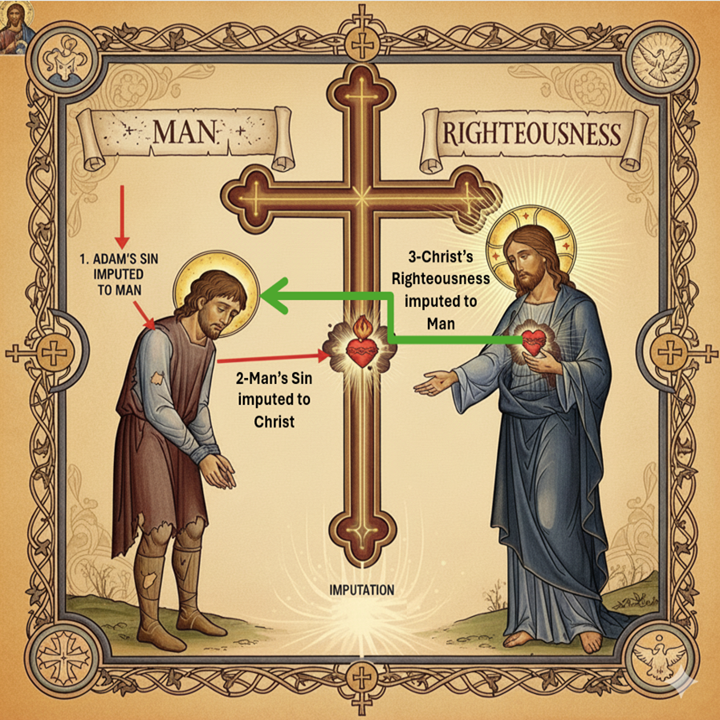
The parallel established above allows us to conclude that God’s plan is based on the doctrine of imputation, which refers to three essential types of imputation:
- First imputation: the imputation of Adam’s sin to humanity. As mentioned earlier, death is part of our spiritual inheritance from Adam.
- Second imputation: the imputation of our sins to Christ. Jesus Christ took upon Himself the sins of those who believe in Him. God the Father imputed our sins to our Lord Jesus Christ, and He suffered the punishment we deserved.
- Third imputation: The imputation of Christ’s righteousness to us. God the Father declares us “righteous” before Him on the basis of our faith in Christ. This is not due to our own merits, but because of the righteousness of Christ imputed to us.
The doctrine of imputation is absolutely central to God’s plan of salvation. Imputation is necessary and is a means of justification. This legal act of declaring ourselves “righteous” does not make us intrinsically perfect, but it makes us perfect in Christ because of what Jesus Christ has accomplished.
Ultimately, the doctrine of imputation is a centerpiece that explains how God reconciles humanity to Himself, while remaining perfectly righteous and holy.
The Imputation of Sin Before and After the Law
Sin is seen as the transgression of God’s law. Transgression of God’s commandments constitutes sin, according to the Law of Moses. Before this explicit law, people did not have such precise knowledge of God’s expectations. Imputation is defined as the attribution or placing of blame on someone. Since death already reigned, as mentioned in verse 14, Paul is not saying that there were no consequences for sin before the Law of Moses. Rather, he is saying that the imputation of sin to man was not the same before and after the Law. In other words, sins were not held accountable in the same way as before and after receiving explicit knowledge of God’s commandments.
- Before the law , sin was imputed to man because it was a reality that separated man from God and brought death.
- After the law , sin is imputed to man because it has become a clear and definite transgression of an explicitly revealed divine will.
Note on the Law : Some commentators suggest that before the law of Moses, there was a form of “natural law” written in the human heart ( Romans 2:14-15 : ” 14 For when the Gentiles, who do not have the law, do by nature the things which are required by the law, these, having not the law, are a law to themselves. 15 They show that the work of the law is written in their hearts, their conscience bearing witness, and their thoughts accusing or defending each other. “). However, Paul here emphasizes the absence of a codified and specifically revealed law.
According to this note, Paul concedes that there were other types of laws before the Mosaic Law, and yes, people transgressed those laws, and yes, it could be argued that those sins are the root cause of death and condemnation in the world. But, Paul says, there is a problem with this view, because death reigned “even over those who had not sinned in the same way as Adam.” There are those who died without having seen a law and without having sinned against it.
Who are these people? The infants who died could not understand personal revelation. They could not read the law in their hearts and choose to obey it or disobey it. Yet they died. Why? Paul answers: Adam’s sin and the imputation of that sin to the human race. In other words, death reigned over all humans, even those who had not sinned against a known and understood law. Therefore, the conclusion is, in the words of Romans 5:18 : ” By one transgression (Adam) condemnation came to all men. ” It is noteworthy that Paul repeated five times, in each verse of Romans 5:15-19 , that by the transgression of one, death comes to all humans.
II- Face to Face of Original Sin and Imputed Sin
The Two Effects of Adam’s Sin: Original and Imputed
Adam’s sin produced two distinct and fundamental effects: original sin and imputed sin. This distinction highlights the dual consequence of Adamic disobedience: a profound alteration of our inner being and a change in our legal status before God.
The table below summarizes the key characteristics of these two aspects of sin:
| Original sin | Imputed sin | |
| Meaning : | Adam’s act of disobedience corrupted his nature, and this fallen nature is passed on to all his descendants. | This is the legal effect of Adam’s sin. God, in His justice, considers that Adam’s act commits the entire human race that he represented. |
| Nature : | Inherited state of sin, fallen human sinful nature. | Legal attribution of Adam’s fault. Legal status before God. |
| Transmission: | Passed down from generation to generation by nature. It is human solidarity. | This is the federal representation of Adam. |
| Consequences : | Spiritual death and separation from God. | Declaration of guilt, divine condemnation. Death. |
| Responsibility : | Responsibility for acting according to our sinful nature. We are responsible for the personal sins we commit because of our sinful nature. | The responsibility for divine sentence rests on the fact that we are legally considered to have participated in Adam’s sin. |
Understanding Original Sin and Imputed Sin: An Analogy for Clarity
To better understand the distinction between original sin and imputed sin, we can resort to explanations by analogy.
Take the example of a contagious disease, such as the Covid-19 virus, whose epidemic has caused millions of deaths worldwide.
Original sin is like being born with the virus of this disease. A newborn baby carries the virus, transmitted by its parents. It has done nothing to contract the disease, but it suffers its potential effects from the start. It is a state of infection present from conception.
The imputed sin is as if, in addition to being born with the virus, a law had been passed declaring all descendants of the first infected person legally responsible for the damage caused by the epidemic, even if they did not personally spread the disease. They are considered part of the problem from the beginning, from the point of view of the law. This is an attribution of legal responsibility.
This analogy has a purely educational purpose; it helps us better understand the nuance between these two concepts.
Understanding these two concepts is crucial to grasping the Christian doctrine of sin and the necessity of redemption in Jesus Christ. God’s grace in Christ offers forgiveness not only for our personal sins, but also a solution to our inherited sinful condition.
III- Adam’s transgression and Christ’s righteousness
It should also be noted that Paul’s objective in Romans 5:12-14 is to show the seriousness of the problem of sin. Whether before or after the law, all humanity is under sin and needs the grace of God manifested in Jesus Christ to be justified. It is also important to point out that these verses highlight that the law exposes sin, but does not solve it. The solution comes only through faith in Christ, who forgives and justifies. Thus, Romans 5:18-19 provides humanity with the solution to the seriousness of sin. Dr. Feddes mentions that “Sin is very, very, very, very, very serious.”
Romans 5:18-19: “ 18 So then, just as through one offense there came condemnation to all, so through one righteousness there came justification and life to all. 19 For just as through one man’s disobedience many were made sinners, so through the obedience of one will many be made righteous. ”
In verse 19, Paul draws a parallel between:
- Made sinners: Paul is saying here that we are made sinners by Adam’s sin. Because of his disobedience, we are considered sinners. We cannot consider “made sinners” here to refer to original sin in which we become inherently sinful. Thus, Paul is saying that we are all made sinners in the sense that we are imputed with Adam’s sin.
- Made righteous: The phrase “made righteous” in this context refers to the great truth of justification. Justification is not about a change of character or the infusion of something inherent into us. Rather, it involves a change in our standing before God. In justification, God declares us righteous because He imputes the righteousness of Christ to us, not because He makes us righteous internally (cf. 2 Corinthians 5:21 ). So when Paul says “made righteous” here, he means “imputed with righteousness,” not “imbued with righteousness.”
In summary, since “made sinners” is paralleled with “made righteous,” Paul must be referring to imputation. Thus, Paul says that we are all “made sinners” in the sense that we are imputed with Adam’s sin, and we are “made righteous” in the sense that we are imputed with Christ’s righteousness. In other words, he wants us to understand that Adam’s sin is imputed to us because we were in him, and so Christ’s righteousness is imputed to us because we are in him. The shorter expression is: Adam’s transgression was imputed to us; and Christ’s righteousness is imputed to us.
IV- Parallel of Sin and Redemption
Sin and Redemption: The Concept of Imputation
1- The Imputation of Adam’s Sin
As the “federal head” or representative of humanity, Adam’s sin not only corrupted his own nature; it was legally attributed to all his descendants. This means that, before God, all human beings are considered guilty of Adam’s sin. Therefore, from birth, humanity is under the condemnation of original sin and imputed sin, and is subject to spiritual and physical death.
2- The Imputation of Our Sins to Christ
In God’s plan of redemption, the sins of those who believe in Jesus Christ were “imputed”—that is, transferred and attributed—to Jesus Himself on the cross. This means that Jesus, who was sinless, legally bore the penalty and guilt for our transgressions. God treated Jesus as if He were the sinner, and He suffered the divine wrath due to those sins.
3- The Imputation of Christ’s Righteousness to Believers
In return, the perfect obedience and righteousness of Jesus Christ—His sinless life and perfect fulfillment of God’s law—are “imputed”—that is, transferred and credited—to believers. This means that, before God, believers are declared righteous not on the basis of their own merits or intrinsic holiness, but on the basis of Christ’s perfect righteousness imputed to them by faith. This is a legal status of righteousness before God.
By Phalin Chou
BIBLIOGRAPHY: Articles from the “Christian Leadership Institute” written by John Piper, Dr. Feddes and Matt Perman

In Christ's Love